
 +971 50 108 6910


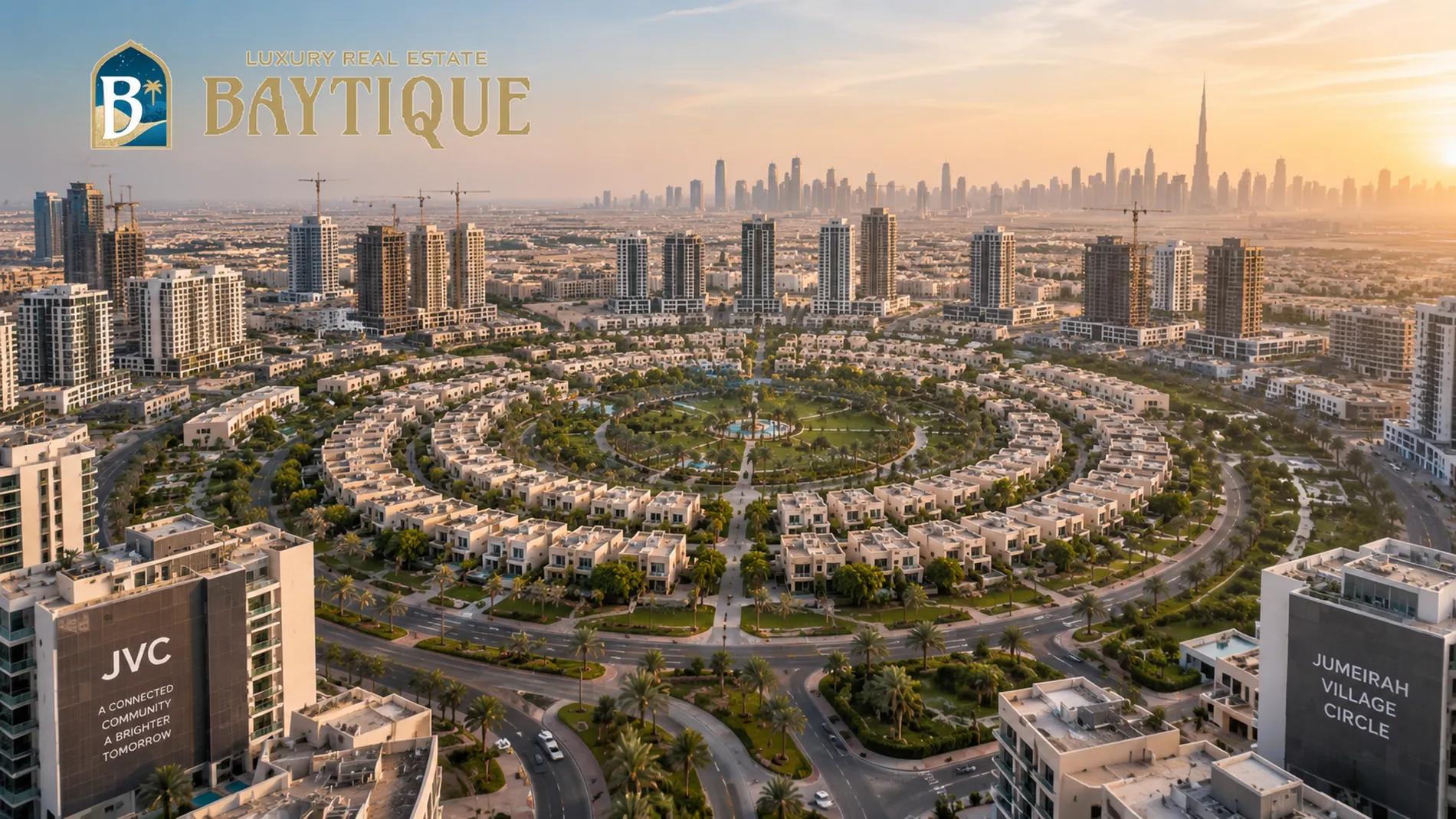

Jumeirah Village Circle (JVC) is one of Dubai’s largest residential communities for buyers looking for a balance between entry price, rental demand, and lifestyle infrastructure.
The area attracts first-time Dubai buyers, investors, and residents who want modern apartments without paying premium prices of waterfront districts such as Dubai Marina or Palm Jumeirah.
However, JVC is not a “buy anything and profit” market. Property performance depends heavily on the individual building, service charges, competition from new projects, and purchase price.
In this guide, we analyse JVC’s property market, rental potential, infrastructure, risks, and what buyers should check before purchasing.
JVC at a Glance
| Factor | Overview |
|---|
| Location | Central Dubai residential community |
| Property type | Mainly studios and apartments |
| Ownership | Freehold |
| Best suited for | Investors, professionals, families |
| Main advantage | Lower entry price compared with premium areas |
| Main limitation | No metro station inside the community |
JVC in the Context of Dubai
The full name of the area is Jumeirah Village Circle, although in everyday conversations and marketing materials it is almost always shortened to JVC. It is part of the larger Jumeirah Village development, with the second major component being Jumeirah Village Triangle (JVT).
The community covers approximately 870 hectares and is structurally divided into around ten internal districts identified by numbers and letters. This is why the phrase “an apartment in JVC” alone says very little about the actual location of a property: the distance from one side of the community to the other can represent a significant drive.
Geographically, JVC is positioned between two major highways: Al Khail Road (E44) on one side and Sheikh Mohammed Bin Zayed Road (E311) on the other, while Hessa Street borders the district from the north. This location provides relatively balanced access to Dubai’s key business and lifestyle hubs.
Dubai Marina, JLT, Dubai Internet City, and Media City are generally around 15–25 minutes away by car outside peak traffic hours. Downtown Dubai and Business Bay are usually around 20–30 minutes away, while Al Maktoum International Airport in the Jebel Ali area is farther but accessible via direct road connections. Actual travel times vary significantly depending on the specific location within JVC and the chosen exit route.
The original concept behind the district was to create a “village” within the city: lower-density development, green corridors, parks, schools, and everyday amenities within easy reach.
Reality turned out to be more complex than the original vision. The internal villa and townhouse areas remain, but the surrounding plots have gradually filled with apartment buildings ranging from around 10 to 20 floors, including many projects completed during the 2020s.
Today, JVC is a hybrid community: a quieter low-rise core surrounded by a denser apartment zone.
This leads to a practical conclusion that we will return to throughout the article: JVC as a location and a specific building within JVC are two completely different objects of analysis.
The average price per square foot across the district combines properties in older buildings completed around 2015, with aging elevators and higher maintenance requirements, and newer towers completed only recently, featuring rooftop pools and significantly higher service charges.
The same applies to average rental yields. They combine apartments with stable long-term tenants and properties that may remain vacant for months.
A buyer is not purchasing an average figure — they are purchasing a specific apartment.
The compromise nature of JVC becomes clear through this comparison. For the same budget, the area offers more space than many coastal and central locations, maintains reasonable travel times to major employment hubs, and provides established daily infrastructure.
In exchange, buyers give up immediate beach access, a premium address, and a metro station within the community.
JVC at a Glance
- A freehold community developed under Nakheel’s master plan from the mid-2000s; the total area is approximately 870 hectares.
- The internal structure consists of around ten districts, with low-rise villas and townhouses in the center and apartment buildings mainly positioned around the perimeter.
- Main access routes include Al Khail Road, Sheikh Mohammed Bin Zayed Road, and Hessa Street.
- More than two hundred residential buildings and one of Dubai’s largest volumes of ongoing residential development.
- There is currently no metro station inside the community; daily transportation relies mainly on private cars, taxis, and RTA bus routes.
- The main property segment consists of studios and one- to two-bedroom apartments; townhouses are significantly fewer, while villas are limited in number.
- The community has its own Circle Mall, several parks, schools, and medical facilities either within JVC or nearby.
Why Property in JVC Is More Affordable
The word “affordable” here should be understood purely as a relative term. It does not mean cheap housing. It refers to a price level that is lower than Dubai’s premium locations while often offering a comparable or even larger living area.
A JVC apartment may still be considered expensive by the standards of many countries where buyers come from — it is simply more affordable than a similarly sized apartment on the beachfront or within a few blocks of Burj Khalifa.
The first reason behind the price difference is the volume of supply.
JVC was originally planned as a large-scale residential community, with many plots allocated for apartment developments. Dozens of developers — from major publicly listed companies to smaller local players — are simultaneously bringing new projects to the market, competing for the same pool of buyers.
This level of competition naturally limits price growth and encourages developers to compete through flexible payment plans, finishing standards, and the range of amenities they provide.
The second reason is the structure of the product itself.
A significant share of new developments consists of compact units: studios of around 350–500 sq ft and one-bedroom apartments ranging from approximately 600–850 sq ft. These properties have a lower absolute purchase price and are designed for tenants with budgets in the range of AED 6,000–8,000 per month.
Premium districts operate with a different product type and target audience. That is why a direct comparison of price per square foot between JVC and areas such as Palm Jumeirah is often misleading: these are fundamentally different products.
The third reason is location.
JVC is situated in the inner part of Dubai, without direct waterfront access, a promenade, canals, or iconic views. These are precisely the features that command the highest premiums in Dubai: the sea, Burj Khalifa views, and prestigious addresses create a significant part of the price gap.
Add the absence of its own metro station, and you get a location discount that reflects real lifestyle limitations rather than simple “undervaluation.”
In Downtown Dubai, buyers pay for proximity to the business core and the global recognition of the address. In Dubai Marina, they pay for the waterfront lifestyle and walkable metro access. On Palm Jumeirah, the premium comes from limited geography and beachfront living.
JVC does not compete with these areas emotionally — it competes through space efficiency and ownership costs.
For the budget of a one-bedroom apartment in Marina, buyers can often find a two-bedroom unit in JVC. A studio budget may provide access to a full one-bedroom apartment with a separate kitchen and more practical living space.
A separate point worth discussing is price per square foot.
It is a useful indicator for quick market comparisons, but it does not show layout efficiency, balcony proportions, construction quality, service charges, or the actual rental income potential.
Two apartments with the same price per square foot can differ significantly in the owner’s net return — sometimes by 1.5 percentage points.
Price per square foot answers the question “Is this expensive or affordable compared with the market?” but it does not answer the question “Is this property profitable?”
What Types of Properties Are Available?
The majority of supply in JVC consists of apartments.
Studios remain the most common format and offer the lowest entry point. In new developments, they are often delivered with finishes, fitted kitchens, and sometimes furniture packages.
One-bedroom apartments are the core product of the district. They represent the widest tenant pool, the largest transaction volume, and broad resale demand.
Two- and three-bedroom apartments are mainly targeted at families. They usually appreciate more slowly on a price-per-square-foot basis but attract more stable long-term tenants.
Townhouses in JVC represent a separate segment, mainly located within the inner clusters of the community.
They are significantly less common than apartments, have a higher absolute purchase price, and usually generate lower gross yields. However, they serve a stable family-oriented demand segment in Dubai.
Villas are limited in number and are rarely viewed as a pure investment product. More often, they are purchased for personal use.
Another important choice is ready property versus off-plan.
Ready properties provide immediate rental potential, allow buyers to inspect the building, neighbors, common areas, and the actual service charge level.
Off-plan properties offer developer payment plans, a lower entry price, and the possibility of capital appreciation before completion. However, they also transfer several risks to the buyer: construction delays, final product quality, and the possibility that several competing projects will be completed nearby at the same time.
In JVC, this last factor is particularly important.
The following figures are indicative market ranges and should not be considered a guaranteed investment return. Actual performance depends on the individual property, purchase price, vacancy, service charges, and management costs.
The figures below represent indicative market ranges and should not be interpreted as guaranteed investment returns. Actual results depend on the specific property, purchase price, vacancy, service charges, financing costs, and rental strategy.
| Property Type | Who Usually Considers It | Main Advantage | What to Check Before Buying |
|---|---|---|---|
| Studio | Investors with a limited budget, first-time Dubai buyers | Lowest entry threshold and potentially attractive gross yield depending on purchase price, rental demand, and operating expenses. | Service charge per sq ft, number of studios in the building, actual rental levels in nearby buildings |
| One-bedroom apartment | Investors and some residents; the widest market segment | Strong liquidity for both rental and resale | Layout efficiency, balcony share of total area, ownership of parking space |
| Two-bedroom apartment | Small families, long-term tenants | More stable tenants and lower turnover | Second bathroom, storage space, proximity to schools and nurseries, quality of elevator systems |
| Three-bedroom apartment | Families buying for personal use | More living space for a budget that may not reach central areas | Demand for this format within the specific cluster, average selling time of similar properties |
| Townhouse | Families and buyers with a 5+ year ownership horizon | Private entrance, outdoor space, family-oriented demand | Master community fees, condition of internal infrastructure, future development plans nearby |
| Off-plan property (any format) | Investors targeting appreciation before completion | Payment flexibility and lower price compared with completed units | Developer track record, project escrow account, volume of competing completions at the same time |
The table highlights a pattern that is easy to miss when simply browsing listings:
The higher the advertised gross yield of a property type, the more operational involvement it usually requires, and the more sensitive the results are to building quality.
Studios often look the most attractive in percentage terms but are also more vulnerable to vacancy periods, rising service charges, and competition from newer studio projects nearby.
The second conclusion concerns the investment horizon.
Compact units are generally focused on cash flow, while larger properties provide greater tenant stability and are often better suited for personal living.
Combining these two goals in a single purchase is usually challenging: a property optimized for short-term rental performance is rarely the same property that offers the most comfortable lifestyle for a family.
Prices, Rental Market, and Investment Returns
This is the most sensitive section, so it is important to start with terminology. In Dubai’s real estate market, at least two different types of figures are often used simultaneously — and they are frequently confused.
Asking price is the price stated in a listing: the seller’s expectation, which is not necessarily confirmed by an actual transaction.
Registered transaction price is the amount recorded in the official transaction database of the Dubai Land Department.
The gap between these two figures in the mass-market segment of JVC can reach 10–15%, and in some individual buildings it can be even wider. Portal statistics are usually based on asking prices, while official statistics rely on completed transactions. As a result, the “average price in JVC” shown by two different sources can differ by hundreds of dirhams per square foot without either source being incorrect.
A similar situation exists with rental prices. A listing usually shows the requested rental rate, while the Ejari registry reflects the actual amount agreed in a signed tenancy contract.

There is another important nuance in 2026: new rental contracts and renewals have moved in different directions. Renewals are affected by the rental index and tend to increase more gradually, while new contracts are negotiated closer to current market levels.
Rental levels in JVC vary depending on the building, apartment type, condition, and current market situation. New contracts may differ from renewals because they are negotiated closer to current market conditions, while existing agreements may follow rental index regulations. This difference means that an owner renting to a new tenant and an owner simply renewing an existing lease can achieve noticeably different income from the same property.
Another important distinction is between average and median prices.
Average prices are heavily influenced by outliers: several expensive penthouses can push the average above the level where most transactions actually take place. For a mass-market community such as JVC, the median figure is usually more representative.
Property prices in JVC vary significantly depending on the building, construction year, developer reputation, apartment size, and service charges. Official transaction data from Dubai Land Department should be used when analysing specific price levels. This indicates a transaction-based benchmark of roughly AED 1,300–1,400 per sq ft.
At the same time, listings often show asking prices of AED 1,450–1,550 per sq ft — which illustrates the difference between asking prices and registered transaction prices.
The primary source for verifying any market figure is the Dubai Land Department open data platform, which provides separate sections covering transactions, rental contracts, projects, buildings, and properties. Any figure from marketing materials should ideally be checked against official records rather than compared with another marketing figure.
When comparing market statistics, it is important to understand the difference between asking prices advertised by sellers and registered transaction prices recorded after completed deals.
| Property type | Approximate price range, AED | Approximate annual rent, AED | Gross yield | Comment |
|---|---|---|---|---|
| Studio | 550,000–850,000 | 40,000–55,000 | ~6.5–8% | The widest variation between buildings; service charges have the strongest impact on the final result |
| 1 bedroom | 850,000–1,300,000 | 60,000–85,000 | ~6–7.5% | The segment with the highest transaction volume and shortest market exposure period |
| 2 bedrooms | 1,300,000–2,000,000 | 90,000–130,000 | ~5.5–7% | More stable tenant profile, lower turnover, but lower gross yield |
| 3 bedrooms | 1,900,000–3,000,000 | 130,000–180,000 | ~5.5–6.5% | More selective demand, depending on the cluster and proximity to schools |
| Townhouse | 2,300,000–3,500,000+ | 160,000–230,000 | ~5–6.5% | Family-oriented segment, longer ownership horizon, and lower competing supply |
The data period covers the first half and middle of 2026. Price ranges are based on registered transactions recorded by the Dubai Land Department and market summaries built on those records. Rental ranges are based on actual contract levels.
All figures in the table are indicative ranges rather than fixed values, because price differences between individual buildings in JVC are often larger than the differences between many Dubai districts.
A specific property can fall outside the range in either direction: a new tower with extensive amenities and strong management may sell above the upper limit, while a 2014–2016 building with high service charges and aging common areas may trade below the lower limit.
2026 Market Dynamics
The market performance in 2026 deserves separate attention because it is moving at two different speeds.
Sale prices in the district remained generally stable, with year-on-year fluctuations of only a few percent depending on the calculation method. At the same time, new rental rates in the mass-market segment stopped increasing and in some cases adjusted downward due to a large volume of new supply entering the market.
For buyers, this leads to a simple conclusion:
Calculating returns based on peak rental rates from 2024 can overestimate the result. The correct approach is to use the rental levels that are being signed today.
Gross vs Net Yield
Gross yield is calculated simply:
Gross yield = annual rental income / purchase price × 100%.
This is the figure most commonly shown in marketing presentations because it looks the most attractive.
However, it does not include any ownership expenses. In Dubai, and particularly in JVC, those expenses can vary significantly.
Expenses deducted from gross rental income include:
- Service charges vary considerably between buildings depending on facilities, building management, age, and maintenance requirements. Buyers should always verify current service charges for a specific property before purchase.
- Vacancy periods between tenants — even in a liquid segment, one to one-and-a-half months without a tenant during a changeover is a normal scenario. In buildings with dozens of similar apartments available at the same time, vacancy can last longer.
- Property management — professional management typically costs around 5% of annual rental income for long-term leasing and significantly more for short-term rental operations.
- Maintenance and repairs — air conditioning, plumbing, cosmetic repairs, and general upkeep do not disappear.
- Furniture costs — for furnished units, initial investment, depreciation, and replacement costs must be considered.
- Broker commissions and operational expenses — including costs associated with finding a new tenant, Ejari registration, and insurance.
Short-term rentals change the entire investment model.
They can generate higher gross revenue, but they require operator licensing, involve significantly higher operating costs, depend heavily on seasonality, and are affected by the rules of individual buildings. Not every building in JVC allows or supports short-term rental operations.
Below is an illustrative calculation, not a forecast or guarantee. The figures are hypothetical and are intended only to demonstrate the mechanics of the calculation, not predict the performance of a specific property.
A one-bedroom apartment of 850 sq ft is purchased for AED 1,000,000 and rented for AED 70,000 per year.
Gross yield: 7%
Then expenses are deducted:
- Service charge at AED 16 per sq ft: AED 13,600
- Property management at 5%: AED 3,500
- Vacancy reserve based on one month every two years: approximately AED 2,900 per year
- Repairs, maintenance, and furniture depreciation: approximately AED 4,000
- Leasing commissions and operational costs averaged annually: approximately AED 3,000
Total expenses: Approximately AED 27,000.
Net income: Approximately AED 43,000.
This gives a net yield of around 4.3% based on the purchase price.
Buyers should also account for transaction costs, including government fees, registration charges, and other purchase-related expenses. The exact amount depends on the transaction structure and should be verified before completion.
A high gross yield does not necessarily translate into the same return for the owner after expenses. Between the number shown in a presentation and the money received in the bank account are service charges, vacancy periods, management fees, and maintenance costs.
The same calculation with a service charge of AED 22 per sq ft instead of AED 16 would reduce annual income by another AED 5,100 and lower the net return by approximately half a percentage point.
This is why service charges should be checked before purchasing, not after the transaction is completed. In JVC, this single line item often explains the difference between two seemingly identical apartments better than almost any other characteristic.
Who Drives Rental Demand in JVC?
Saying that “JVC has strong rental demand” is not enough. The important question is: who exactly is renting here and what are they looking for?
The overall market environment remains supportive. According to Dubai Land Department data, around 1.38 million rental contracts were registered across Dubai in 2025 — 6% more by volume and 17% higher by value compared with the previous year, while the number of new contracts exceeded 513,000. This data reflects the emirate-wide rental environment rather than one specific building in JVC.
The core rental audience in JVC consists of working professionals with mid-range incomes.
Young specialists from finance, technology, media, and tourism often choose studios and one-bedroom apartments because JVC provides modern housing with amenities such as pools and gyms at prices below areas like Dubai Marina or Business Bay.
Couples without children often choose the same segment, prioritizing layout quality and balcony space.
The second major group is small families.
They typically look for two-bedroom apartments, additional bathrooms, storage space, parking, and nearby schools. These tenants usually move less frequently, negotiate more carefully, and pay more attention to building quality and common areas.
For owners, this means slightly lower gross returns but also lower turnover, fewer vacancies, and fewer leasing costs.
Another important group consists of employees working in areas such as Dubai Marina, JLT, Dubai Internet City, Media City, and Al Quoz.
For them, JVC represents a compromise between rental affordability and commuting time. This group often evaluates the exact location of a building rather than just the reputation of the district.
A property’s position relative to Al Khail Road or Hessa Street can matter significantly: an additional 15 minutes spent navigating internal JVC traffic during rush hour may outweigh a rental discount of several thousand dirhams per year.
There is also a noticeable share of tenants who prioritize space and finishing quality over prestige.
This includes some remote workers and professionals with flexible schedules. They are less concerned about being close to an office but place more importance on quiet surroundings, reliable internet, workspace availability, and cafés and shops within walking distance.
This group is especially sensitive to nearby construction because they spend more time at home.
The connection between audience and property type is straightforward.
Studios and one-bedroom apartments serve the largest and most mobile segment: easier leasing, but higher tenant turnover.
Two-bedroom apartments appeal more to families: potentially longer occupancy, but a narrower tenant pool.
Townhouses target families with a longer-term lifestyle perspective and compete in a different market segment.
The practical conclusion is simple.
Layout efficiency, dedicated parking, elevator quality, air-conditioning systems, the condition of common areas, and proximity to exits often influence tenant decisions more than the number of pools shown in a marketing render.
Tenants live in apartments and commute to work — they do not buy the lifestyle shown in a lobby brochure.
What Increases Rental Appeal and Liquidity of an Apartment?
- Efficient layouts without unnecessary corridors and with a reasonable balcony-to-living-space ratio.
- A dedicated parking space assigned to the apartment rather than “available when possible.”
- A building located within 3–5 minutes of access points to Al Khail Road or Hessa Street.
- Functional nearby infrastructure: supermarkets, pharmacies, cafés, and children’s play areas.
- Well-maintained common areas and a reliable property management company — factors visible during the first viewing.
- No active construction directly outside the windows or around the only access point.
- A quieter building orientation and views that do not face a blank wall of a neighboring tower.
- Moderate service charges — they do not directly affect tenants, but they give owners more flexibility when negotiating rental rates.
Infrastructure and Daily Life
The everyday environment in JVC has changed more significantly in recent years than property prices themselves. For a long time, the area was criticized mainly for its lack of infrastructure: residential buildings were completed faster than shops, schools, and roads appeared. Today, the situation is different, although development remains uneven across different clusters.
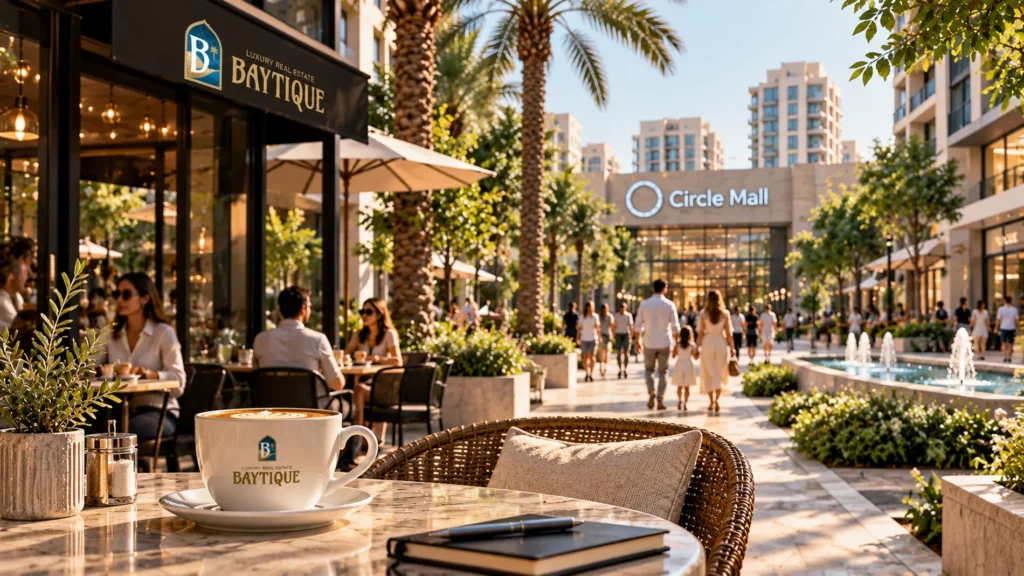
The main commercial hub is Circle Mall, a Nakheel shopping center that opened in 2021 in the central part of the community. Inside, residents have access to a large supermarket, cinema, food court, pharmacies, clinics, everyday retail stores, and children’s entertainment areas. The opening of the mall addressed one of the main complaints about JVC: residents no longer need to drive to Mall of the Emirates for basic shopping needs.
Beyond the mall, smaller supermarkets, laundries, beauty salons, cafés, and restaurants operate throughout the community, including retail spaces on the ground floors of residential buildings — a typical Dubai-style “community retail” model.
Green spaces were included in the original master plan, and many have already been delivered. JVC has dozens of smaller parks and landscaped areas with children’s playgrounds, walking paths, and barbecue zones. There is no large central park on the scale of Dubai’s major urban parks, but the density of smaller green pockets is higher than in many apartment-focused communities across Dubai.
Sports facilities are mostly concentrated within residential buildings: swimming pools, gyms, occasional padel courts, and rooftop facilities, along with several commercial fitness clubs and studios.
The educational infrastructure is developing both inside JVC and in nearby communities. Within JVC itself, JSS International School operates and is listed in the official KHDA directory as a school located in Jumeirah Village Circle (South), following an Indian curriculum. Several other schools offering British, American, and Indian curricula are located within a 10–20 minute drive in areas such as Dubai Sports City, Al Barsha South, and Motor City.
Nurseries are available directly within residential clusters, which is often even more important for families than school access: having a nursery within walking distance significantly simplifies daily routines.
Healthcare infrastructure covers everyday needs. Clinics, dental practices, and pharmacies operate within JVC and Circle Mall, while larger hospitals and specialized medical facilities are located in areas such as Al Barsha, Motor City, and Dubai Healthcare City.
For most daily situations, residents do not need to leave the community. For more serious medical needs, however, traveling outside JVC is usually necessary.
The family-oriented character of JVC developed naturally. A combination of relatively accessible two-bedroom apartments, townhouses, parks, and landscaped areas attracts exactly this type of resident.
At the same time, JVC contains very different micro-environments. Clusters dominated by villas feel more like quiet suburban neighborhoods, while areas with dense high-rise apartment towers along the perimeter resemble typical urban districts, with associated effects such as traffic and noise.
Transport
The transport logic of JVC is straightforward: the community was designed primarily for car use.
Internal roads are circular and relatively narrow, distances between clusters can be inconvenient for pedestrians, and Dubai’s summer heat makes walking distances of one kilometer or more a seasonal challenge rather than a realistic year-round routine.
There is currently no metro station inside JVC.
The nearest metro stations require a short drive by taxi, bus, or private vehicle, with travel time depending on the exact location inside JVC and traffic conditions.
No confirmed plans for a metro station directly inside JVC have been announced at the time of writing, so buyers should not treat a future metro connection as an expected price-growth driver for the area.
Public transport is provided through RTA bus routes connecting JVC with metro stations and neighboring communities, as well as the Dubai Bus On Demand service, which includes Jumeirah Village Circle within its operating zone.
Transport networks are regularly updated. For example, RTA adjusted the J01 route within JVC in late August 2025 as part of a wider network update.
Before judging whether a specific building is genuinely walkable to public transport, it is worth checking the latest RTA information. Outdated transport data often remains unchanged in area guides for years.
Traffic conditions depend heavily on the time of day and the exit route used.
Morning and evening rush hours create noticeable congestion when leaving toward Al Khail Road and Hessa Street. Internal circular roads can also become crowded during school drop-off and pick-up times.
A practical recommendation for buyers is simple: visit the building twice — once on a weekday around 8:00 AM and again around 6:00 PM — and test the actual route to your workplace instead of relying only on a map.
What Supports JVC’s Growth Potential
The statement “the area is developing, therefore prices will rise” is not a strong investment argument.
A more useful approach is to break the potential into specific mechanisms, each of which can be analyzed separately and each of which has limitations.
1. Overall Dubai Housing Market Dynamics
Dubai’s population continues to grow, and this growth is accompanied by increasing numbers of rental contracts and registered property transactions.
DLD data for 2025 shows growth in both the number and total value of rental contracts, as well as an increase in completed projects.
This broader market environment creates demand across different segments, including the mass-market housing sector.
2. Structural Demand for Mid-Market Housing
The majority of Dubai residents cannot afford Downtown Dubai or Palm Jumeirah — and many will never target those segments.
Their budgets create demand in the rental range of approximately AED 40,000–120,000 per year.
JVC is one of the largest suppliers of residential stock within this segment. As long as Dubai continues attracting middle-income professionals, demand for this type of housing is likely to remain present.
3. Low Entry Barpool can support transaction activity and reduce resale exposure periods.
This is a liquidity factor — not a guarantee of price growth.
4. Maturing Infrastructure
Circle Mall, schools, clinics, supermarkets, and ground-floor cafés appeared after much of the residential construction and continue to expand.
The area is gradually moving from a collection of residential towers surrounded by construction sites toward a more established community.
This directly affects rental appeal: tenants are generally more willing to pay for homes located within functioning communities rather than isolated buildings surrounded by undeveloped areas.
5. Renewal of the Residential Stock
Newer projects launched in recent years generally offer improved finishes, engineering systems, and shared facilities compared with much of the 2012–2016 housing stock.
The arrival of modern developments raises the overall quality level of the community and supports stronger rental positioning for better-performing buildings.
6. Liquidity of the Mass-Market Segment
JVC consistently ranks among Dubai’s areas with a high number of registered transactions.
For investors, this means a more predictable exit environment: The wider buyer pool of the mass-market segment can create more potential demand compared with highly specialized luxury properties. However, resale liquidity still depends on the specific building, pricing strategy, and market conditions.
Each of these mechanisms creates potential, not guarantees.
Dubai’s overall market performance does not automatically translate into identical results for JVC. A community with one of the city’s largest construction pipelines behaves differently from a location with limited supply where new development is physically restricted.
Dubai’s market growth creates a favorable environment, but the value of a specific JVC apartment depends on local supply, building quality, entry price, and competition from upcoming projects nearby.
This distinction becomes especially important when looking at 2026 conditions. Despite strong city-wide demand, rental growth for new contracts in the mass-market JVC segment has slowed.
Demand remains present — but supply growth has temporarily moved ahead of demand growth.
This is a normal cycle for a community where a significant amount of housing is delivered simultaneously. It also shows why city-wide statistics cannot replace analysis of the local balance between supply and demand.
Why Growth Does Not Mean Every Property Will Increase in Value
A growing community does not automatically guarantee price appreciation for every apartment. In JVC, differences between buildings can be significant because buyers compare new projects, service charges, layouts, amenities, and management quality.
Risks That Should Not Be Ignored
The main risk in JVC is directly connected to its biggest advantage.
A community where construction is relatively easy and entry prices remain accessible naturally becomes a highly competitive market for property owners.
Volume of New Supply
JVC has one of the largest development pipelines among Dubai communities of a similar size.
JVC continues to receive a significant amount of new residential supply, increasing competition between existing and newly completed properties.
When several towers are handed over within the same area over a short period, a large number of similar units enter the rental market simultaneously.
The result can be longer listing periods and pressure on rental prices, which has already been visible in some new rental contracts in 2026.
Competition Between New and Existing Properties
A tenant with a AED 70,000 rental budget does not compare your 2016 apartment only with another 2016 apartment.
They compare it with a newly completed tower across the street, where finishes are newer and amenities may include rooftop pools or upgraded facilities.
Older buildings in JVC can lose rental competitiveness faster than properties in communities with limited new construction.

Variation in Construction Quality
Dozens of developers have operated in JVC, from established companies with transparent reporting to smaller local developers with shorter track records.
The difference often becomes visible not in marketing materials, but after two or three years of operation:
— facade condition
— elevator performance
— cooling systems
— quality of common-area management
Service Charges
Service charges in JVC vary significantly between buildings depending on amenities, management quality, age, and maintenance requirements. Buyers should verify current charges for the specific building before purchase.
Buildings with extensive amenities usually have higher maintenance costs, and these expenses are paid by owners rather than tenants.
Before purchasing, buyers should request several years of service charge history. The trend matters as much as the current amount.
Quality of Management
The management company influences cleanliness, security, maintenance response times, and ultimately the building’s rental reputation.
A poorly managed building can lose market appeal even if the original construction quality was strong.
Constructistion and Lack of Metro Access
Peak-hour traffic and limited alternatives to driving remain important considerations.
For some tenants, this can become a deciding factor regardless of improvements inside the building.
Uneven Character of the Community
A villa-focused cluster with quiet streets and greenery is effectively a different market from a high-density tower cluster near busy intersections.
Both may officially be located in JVC, but rental demand, pricing, and liquidity can differ significantly.
Paying Too Much for Amenities
Cinema rooms, coworking spaces, multiple pools, and impressive lobbies look attractive in presentations.
However, they also increase purchase prices and service charges. Their impact on rental premiums is not always proportional.
Off-Plan vs Ready Property
Off-plan purchases add additional risks:
— construction delays
— differences between renderings and the final product
— simultaneous handovers of competing projects
Buying Based on Promised Returns
Guaranteed returns and attractive percentage figures in presentations are marketing tools.
The correct approach is to analyze actual rental contracts in the same building and comparable nearby properties.
| Factor | Why It Is Positive | Where the Risk Appears | What Buyers Should Check |
|---|---|---|---|
| Large supply | Wide choice and stronger negotiation opportunities | Competition between owners when renting or reselling | Number of similar units in the building and nearby area |
| Many new projects | Modern housing stock, updated facilities, payment plans | Local oversupply during major handover periods | Delivery schedule of nearby projects for the next 12–24 months |
| Accessible entry prices | Expands buyer pool and supports liquidity | Attracts speculative investors entering and exiting at the same time | Share of investors versus residents in the building |
| Strong rental demand | Faster leasing and more stable income potential | Demand exists for specific products, not every apartment | Actual Ejari contracts rather than advertised asking prices |
| Developed infrastructure | Improves tenant appeal and rental positioning | Infrastructure quality differs between clusters | What is genuinely within walking distance |
| Transport access | Direct connections to major roads | No metro station and peak-hour congestion | Real driving test during rush hour |
| Developer diversity | Wider choice of formats and prices | Uneven quality and management standards | Developer track record and condition of completed projects |
The table illustrates the main principle of JVC: almost every factor works in two directions.
Large supply means more choice for buyers but also more competition for owners.
Affordable pricing supports liquidity but can also attract synchronized investor behavior.
Many developers create variety but also create differences in quality.
In JVC, choosing the right building is often more important than analyzing the average performance of the entire community. The gap between the strongest and weakest buildings within the same area can exceed the difference between neighborhoods.
The key rule is simple:
Do not evaluate an abstract “district yield.” Analyze the economics of the specific property: purchase price, service charges, actual rental performance, and competing supply expected over the next two years.
The average JVC figure should be treated as a comparison point — not as the sole basis for an investment decision.
How to Choose Property in JVC
A practical step-by-step approach matters more than any project ranking. Below is a due diligence sequence that helps eliminate unsuitable options before viewings and allows you to compare the remaining properties correctly.
1. Define your purchase goal.
Living in the property yourself, long-term rental, short-term rental, and off-plan resale require different types of properties. There is no universal solution, and trying to combine several objectives usually weakens the result for each one.
2. Fix your total budget.
The purchase price is only part of the equation. Additional costs include the 4% DLD registration fee, administrative charges, brokerage fees, and, if needed, furniture and mortgage-related expenses. A realistic estimate for total entry costs is around 7–8% above the property price.
3. Decide between ready and off-plan.
A ready property generates income immediately and allows you to evaluate the actual condition of the building. Off-plan properties usually offer payment plans and a lower entry price, but they require more flexibility regarding timelines and a higher tolerance for uncertainty.
4. Check registered transactions.
Compare the asking price with actual transactions for the same building and nearby buildings over the previous 6–12 months using publicly available DLD data. A difference of more than 10% requires an explanation.
5. Compare real rental performance.
Focus on completed rental contracts and current rates for newly signed agreements rather than listing prices or outdated figures from two years ago.
6. Study the developer’s track record.
Check how many projects have been completed, whether there were delays, and what condition completed buildings remain in three to five years after handover.
7. Request service charges and their history.
Review the cost per square foot, what is included, whether district cooling is charged separately, and how the amount has changed over recent years.
8. Evaluate the layout.
Look at the usable area compared with the total area, balcony size, storage availability, bathroom configuration, and views from the main windows.
9. Check parking.
An assigned parking space, its location, and the availability of guest parking are frequent weak points in high-density developments.
10. Inspect the surroundings of the building.
Look at what is within walking distance, the condition of neighboring buildings, traffic levels on internal roads, availability of shade, and landscaping.
11. Assess future construction nearby.
Check vacant plots, active construction sites, and announced projects. These factors affect both living comfort and future rental competition.
12. Calculate net yield.
Take the rental income after all actual expenses and divide it by the full acquisition cost. Use a conservative rental estimate and include a vacancy reserve.
13. Think about your exit strategy.
Consider who you will sell the property to in three to five years, how many similar units will be competing on the market, and what will make your property stand out.
If you are comparing several projects in JVC or want to understand how the area compares with other Dubai locations, start with a short property selection process — World Estate Homes specialists can help narrow down the options based on your budget, purchase goal, and expected holding period.
Negotiation and Timing: What Buyers Should Know
In a high-supply market like JVC, buyers often have room for negotiation, especially with ready properties where the seller is an investor rather than an owner-occupier.
A difference of 5–10% between the asking price and the final transaction price in the mass-market segment of JVC can be a realistic scenario, and this difference can determine whether your net yield ends up closer to four percent or five percent.
The entry price is the only profitability factor that a buyer can fully control.
Another practical point is viewing the property at different times.
A building that appears quiet on a Sunday afternoon may feel completely different on a weekday evening, when all air-conditioning systems are running, parking areas are full, and nearby construction activity is underway.
Two visits at different times of day can reveal details that no rendering will ever show.
JVC or Another Dubai Area?
| Area | Best for | Main advantage | Main limitation |
|---|---|---|---|
| JVC | First-time buyers, investors | Lower entry point | No metro |
| Dubai Marina | Waterfront lifestyle | Beach and metro access | Higher prices |
| Downtown Dubai | Premium location | Business/tourism hub | Expensive entry |
| Dubai Hills | Families | New infrastructure | Higher prices |
A comparison only makes sense between areas with a similar market logic. Comparing JVC with Palm Jumeirah is meaningless — these are completely different property categories.
However, choosing between JVC and other mid-market locations with a similar budget is a common decision for buyers.
Dubai Sports City is located nearby and operates within a similar budget range, but it is structurally younger and more spread out. Sports infrastructure is its main advantage, while everyday amenities are less developed compared with JVC. The transport model is similar — car-based.
Arjan offers a comparable price level with an even stronger focus on new construction. The area is younger and closer to Al Barsha South and Dubai Miracle Garden, but its everyday environment is still developing, and the share of under-construction properties remains higher. For investors, this means earlier entry but also greater uncertainty regarding how quickly the area will mature.
Dubai Hills Estate represents the next pricing tier. It requires a higher entry budget and offers a more extensive master plan, a park, golf course, major shopping facilities, and a more premium tenant profile. Gross yields are usually lower than in JVC, but competition within the same segment is lower and rental rates tend to be more resilient.
Dubai Marina and Business Bay represent a different scenario: significantly higher entry prices, but also a different product — urban lifestyle, waterfront access, metro connectivity, and a stronger short-term rental market. Gross yields are usually lower than in JVC, while resale liquidity is stronger among internationally oriented buyers.
| Area | Price Positioning | Main Audience | Main Strength | Main Trade-off |
|---|---|---|---|---|
| JVC | Mass market, lower entry threshold | Working residents, small families, first-time investors | More space for the budget and high transaction activity | Large competing supply and no metro station |
| Dubai Sports City | Close to JVC, sometimes lower | Young professionals, sports-oriented residents | Sports facilities and spacious layouts | Less mature daily infrastructure |
| Arjan | Mass market, significant new construction | Investors focused on off-plan opportunities | New inventory and accessible entry prices | Developing area with a high share of construction |
| Dubai Hills Estate | Upper mid-market | Higher-income families | Mature environment, park, mall, stable tenant profile | Higher entry price with lower gross yield |
| Dubai Marina / Business Bay | Premium urban segment | International tenants, short-term rental market | Metro access, waterfront lifestyle, strong tourism demand | High entry price and lower gross yield |
Exact price comparisons between districts become outdated quickly, so the comparison above is based on the character of each area rather than specific figures. For current average prices, it is more reliable to refer to DLD transaction records at the time of purchase.
The practical decision-making framework should be based on the tenant profile and investment horizon.
If your strategy is generating cash flow in the mass rental market and you are prepared for competition, JVC remains one of the most logical options.
If your priority is rental stability and a higher-quality environment while accepting a lower yield percentage, upper mid-market areas may be more suitable.
If walking distance to metro stations and waterfront areas is essential, there is no direct compromise within the JVC budget — the budget or location criteria will need to change.
Who Is JVC Suitable For?

The most useful way to evaluate JVC is through different buyer scenarios, because the same district can be a strong choice for one person and a poor fit for another.
JVC is not universal. It solves a specific set of needs and is less suitable for others.
JVC is suitable for:
- Investors focused on the mass long-term rental market who are prepared to compete: the tenant base is clear, rental demand is active, and exit liquidity is generally easier to evaluate.
- First-time Dubai property buyers: the lower entry threshold allows them to learn the market, registration process, and property management without taking on excessive exposure.
- Families who value space, parks, schools, and nurseries but do not have the budget for Dubai Hills or Dubai Marina.
- People for whom driving is a normal part of daily life rather than an inconvenience.
- Buyers willing to spend time selecting a specific building, checking service charges, and analyzing nearby construction — this research often creates the biggest difference in results.
JVC may not be suitable for:
- Buyers who consider walking distance to a metro station essential: JVC does not have a metro station within the community, and no confirmed near-term metro opening has been announced.
- Investors looking for ultra-premium, limited-supply properties: JVC operates in the opposite segment, with significant competition and a large volume of available units.
- Those seeking a beach lifestyle and daily access to the sea.
- Buyers who do not want to compare hundreds of competing projects and prefer a “buy in a good area and forget about it” approach.
- Investors who rely only on developer projections without independently checking rental contracts and operating expenses.
Between these two groups is another category: buyers purchasing a home for themselves but keeping the option of renting it out in the future.
For them, it makes sense to choose a property using tenant-focused criteria, even if they plan to live there themselves: efficient layouts, assigned parking, reasonable service charges, and convenient access routes improve both daily comfort and future liquidity.
The balance between “for living” and “for renting” is often easier to achieve in JVC than in premium districts, where these two scenarios tend to separate more clearly.
There is no universal answer of “buy” or “do not buy” when it comes to JVC.
It is a practical tool for specific goals and the wrong choice for others. The right decision depends on your purpose, investment horizon, and willingness to analyze the details of the specific property.
How World Estate Homes Helps Buyers Evaluate JVC Properties
Choosing property in JVC requires analysing more than the advertised price. Our approach focuses on comparing buildings, checking ownership costs, evaluating rental demand, and matching properties with the buyer’s goals — whether the priority is personal residence, rental income, or long-term ownership.
Is JVC Worth Considering?
JVC remains one of Dubai’s key mid-market residential districts, and this position is supported not by marketing claims, but by the structure of the market itself: a high volume of transactions, a broad rental audience, and a product offering that matches the budgets of a large share of the emirate’s working residents.
A relatively accessible entry price and consistent demand for compact apartments create a clear market rationale. At the same time, the district’s infrastructure has become noticeably more mature in recent years — Circle Mall, schools, clinics, and parks have addressed many of the concerns that previously surrounded the area.
However, the same factor that drives JVC’s appeal also creates its main challenge: the scale of construction. A large volume of new supply gives buyers more choice, modernizes the housing stock, and at the same time increases competition between landlords for tenants.
Rental rates for new contracts in 2026 have already started reflecting this shift. A district without a metro connection, built around car-based mobility, and with significant differences in construction quality requires buyers to conduct more thorough research than locations with limited supply and a more consistent product offering.
A large pipeline of new projects expands buyer choice while increasing competition between owners — and ultimately, the winner is the buyer who chooses the right building, not simply the right district.
The practical conclusion is simple: in JVC, the decision is made at the level of a specific building and a specific price point.
Verified transaction data instead of asking prices, actual rental contracts instead of projected returns, real service charges instead of average estimates, and a timeline of upcoming nearby completions instead of general statements about district growth — these four checks are enough to separate a strong purchase from an average one within the same neighborhood.
This material is for informational purposes only. It is based on publicly available data and market reports current as of mid-2026 and does not constitute individual investment advice. Before completing a transaction, it is advisable to verify the latest figures for the specific property through the Dubai Land Department registry.
 Real estate in Georgia
 Real estate in Cyprus
 Real estate in Montenegro
 Real estate in Bali
 Real estate in Thailand
 Real estate in Spain
 Real estate in Saudi Arabia
 Real estate in Turkey
 Real estate in Zanzibar
 +971 50 108 6910
 hello@baytique-uae.com
 UAE, Dubai, Dubai Hills Estate, Park Heights Square 1


 Get catalogue of TOP-7 objects