
 +971 50 108 6910


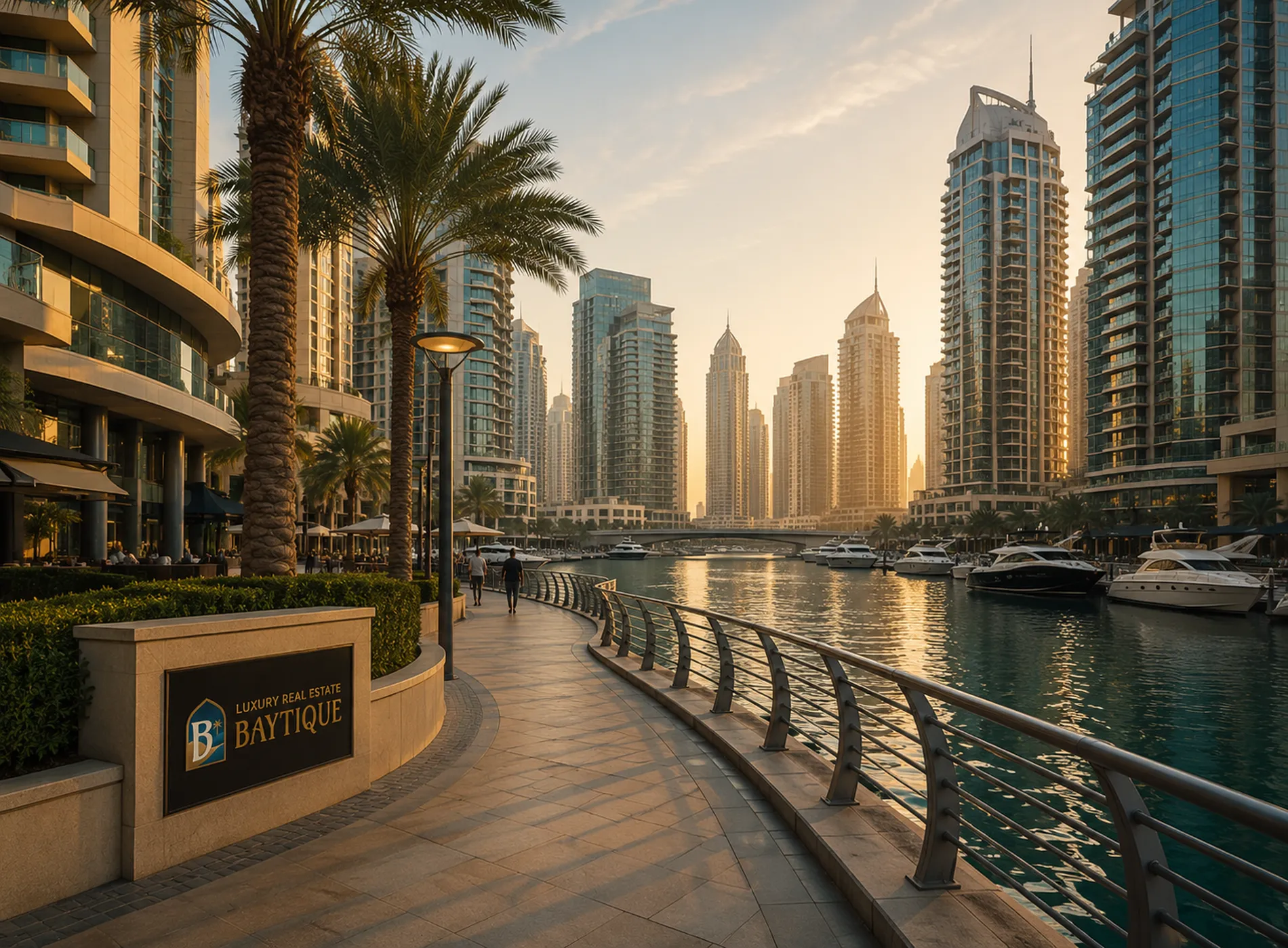
Dubai Marina: Property and Waterfront Living
Dubai Marina is one of Dubai’s most recognizable neighborhoods, but it would be misleading to view it solely as a tourist attraction or a district defined by skyscrapers. Over the past two decades, it has evolved into a fully developed residential community, with strong transport links, extensive everyday infrastructure, a diverse property market, and its iconic waterfront promenade, used daily not only by visitors but also by people who live in the area year-round.
It is important to understand that Dubai Marina is not a uniform neighborhood offering the same quality of life throughout. Two apartments with the same Dubai Marina address can differ significantly in comfort, noise levels, views, transport accessibility, and ongoing ownership costs, depending on the building itself and the specific part of the district in which it is located.
This guide takes a detailed look at Dubai Marina as a place to live, covering its location, property types, key pricing factors, infrastructure, transport connections, real advantages and limitations, as well as practical recommendations for anyone considering buying or renting an apartment in the area.
Where Dubai Marina Is Located
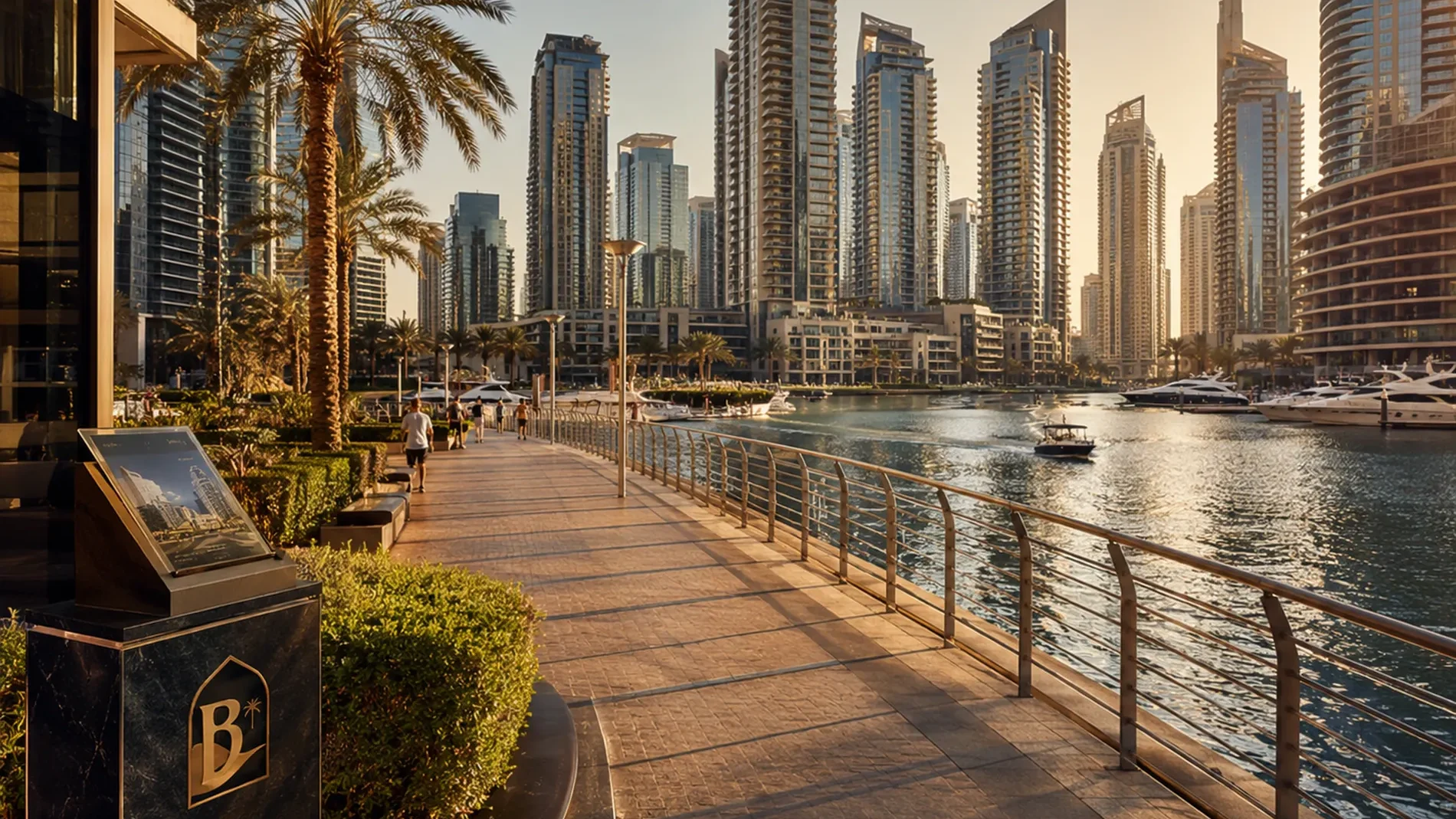
Dubai Marina is situated in the western part of Dubai, along the Persian Gulf coastline, approximately 25–30 kilometres from the city’s historic centre. The district is built around a 3.5-kilometre artificial canal with access to the sea.
Geographically, Dubai Marina sits in close proximity to several other major districts. Dubai Marina is closely connected to several major neighbouring districts. Jumeirah Lake Towers (JLT) lies on the opposite side of Sheikh Zayed Road, while Jumeirah Beach Residence (JBR) directly adjoins Dubai Marina on the waterfront side. Palm Jumeirah is located further along the coastline.
It is important to distinguish between Dubai Marina and JBR. Although the two areas are closely interconnected in everyday life and residents can easily walk between them, they are separate residential districts with different development patterns, management structures, and property markets. Dubai Marina is dominated by high-rise residential towers lining the canal, while JBR consists of larger, more cohesive residential complexes with direct access to the beach.
Sheikh Zayed Road provides convenient road connections to Dubai’s main business districts, including Downtown Dubai, Business Bay, Dubai Media City, and Dubai Internet City. The latter two are located particularly close to the Marina, making the area a natural choice for professionals working in the media and technology sectors.
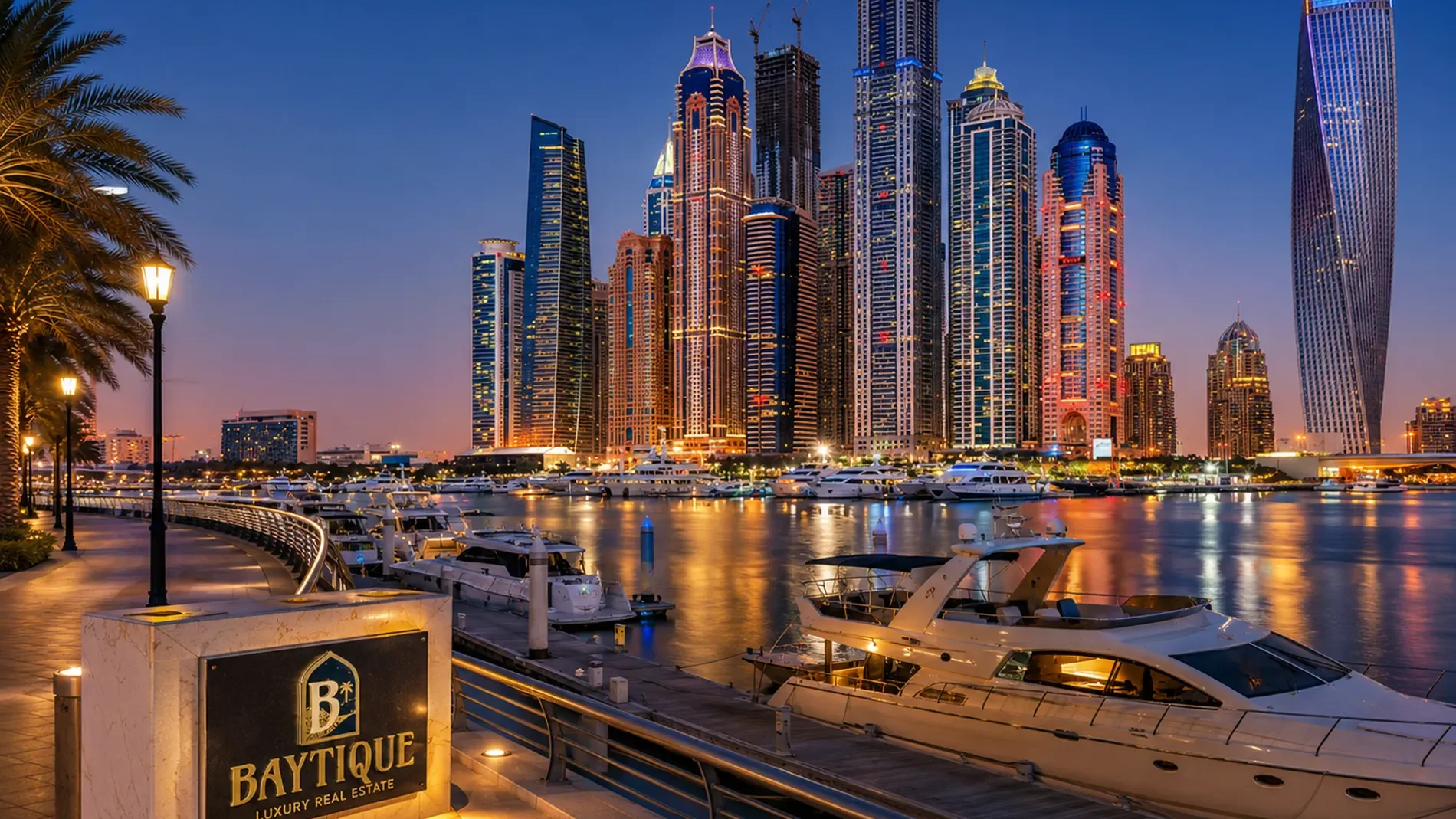
The canal is fundamental to the way the district is organised and experienced. It shapes the entire character of Dubai Marina: Marina Walk has developed along its waterfront, creating a pedestrian promenade lined with restaurants, cafés, marinas, and dedicated paths for running and walking. Without the canal, Dubai Marina would essentially be a dense cluster of residential skyscrapers. The presence of the water is what creates the distinctive waterfront environment that attracts many people to the area in the first place.
Dubai Marina also has one of the highest concentrations of high-rise residential development in Dubai. The towers are positioned relatively close to one another, which creates a distinctly urban atmosphere but also affects views, natural light inside apartments, and the overall sense of space. For a broader comparison with other residential areas of Dubai — from denser urban districts to more open, lower-density communities — see this overview of Dubai’s real estate districts and infrastructure.
How the Neighborhood Is Laid Out
Dubai Marina is compact, yet remarkably dense in terms of amenities and urban life. Within a relatively compact area, a high concentration of residential towers coexists with hotels, retail outlets, restaurants, cafés, fitness clubs, and marina facilities. This concentration of functions is one of the neighborhood’s main practical advantages, particularly for residents who value being able to handle most everyday needs on foot or within just a few minutes of home.
Much of the character of Dubai Marina’s public realm is shaped by Marina Walk, the waterfront promenade that runs for approximately 7 kilometers along the canal. It is far more than a pedestrian walkway: the tram line follows part of its route, while restaurants and cafés, yacht berths, water taxi stops, and jogging paths line the waterfront. Marina Walk remains lively in the evenings throughout the year, although daytime walking becomes significantly less practical during the summer months, from June through September, because of the heat.
When choosing an apartment in Dubai Marina, it is important to assess not only the neighborhood itself, but also the individual tower and its position in relation to roads, public transport, the waterfront, and surrounding development.
The district is far from uniform in character. Properties directly facing the canal or open water can feel noticeably different from those in the more densely built-up interior, where towers stand close together and views may consist largely of neighboring façades. Areas near major retail destinations and key access points to the main highway tend to experience heavier traffic, particularly during peak hours. Quieter pockets are generally found farther away from Sheikh Zayed Road.
Tourist activity is also a genuine part of everyday life in Dubai Marina. The neighborhood attracts a substantial number of visitors, drawn by sightseeing yachts, waterfront dining, and Marina Mall. On weekends and public holidays, both pedestrian and vehicle traffic increase noticeably. For those who enjoy being part of a vibrant, active urban environment, this can be a major advantage. For anyone seeking peace, privacy, and a more secluded residential atmosphere, it may be one of the strongest reasons to consider a different area.
The connection with JBR is particularly practical: many parts of Dubai Marina offer convenient walking access to JBR Beach and The Walk, although the actual walking time depends on the location of the individual tower. This gives residents easy access to public beachfront spaces without needing a car—an important advantage for those who see waterfront living not simply as a view from the window, but as part of their everyday lifestyle.
Real Estate in Dubai Marina
Dubai Marina has one of the most diverse residential property markets among Dubai’s established neighborhoods. The area offers apartments in virtually every format, from compact studios to spacious family residences and penthouses. This variety attracts an equally broad range of residents and buyers — from single professionals moving into their first independent home in Dubai to purchasers looking for a prestigious waterfront apartment.
Studios occupy the more affordable end of the market and remain popular with tenants, including young professionals as well as people coming to Dubai for short- or medium-term stays. One-bedroom apartments are the most widely available property type in the area, combining a relatively accessible price point with enough space for comfortable everyday living. Two- and three-bedroom apartments are typically suited to couples, smaller families, and buyers who need a separate home office. Larger apartments with four or more bedrooms, along with penthouses, are available in more limited numbers and are concentrated in several of Dubai Marina’s best-known developments.
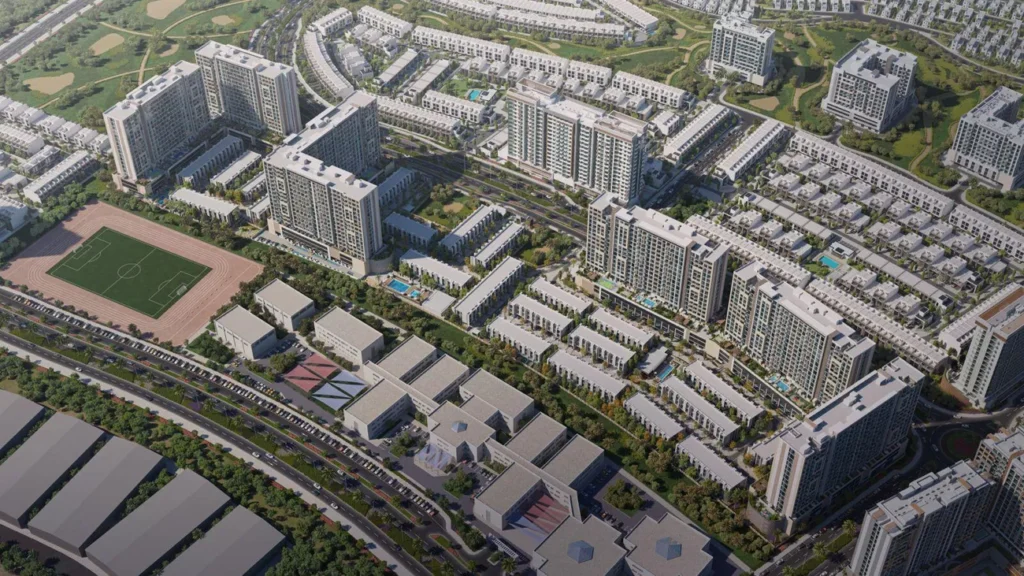

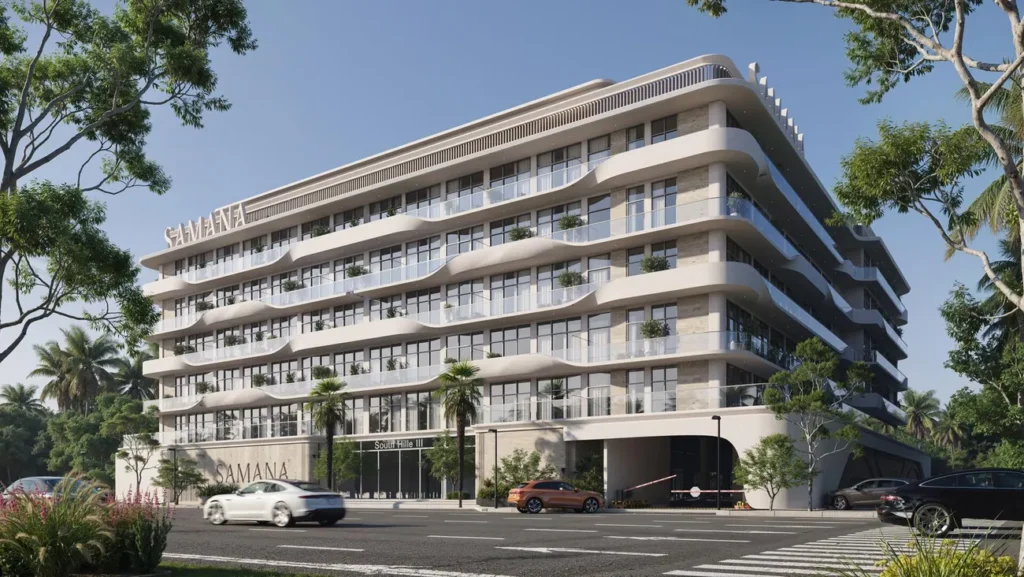
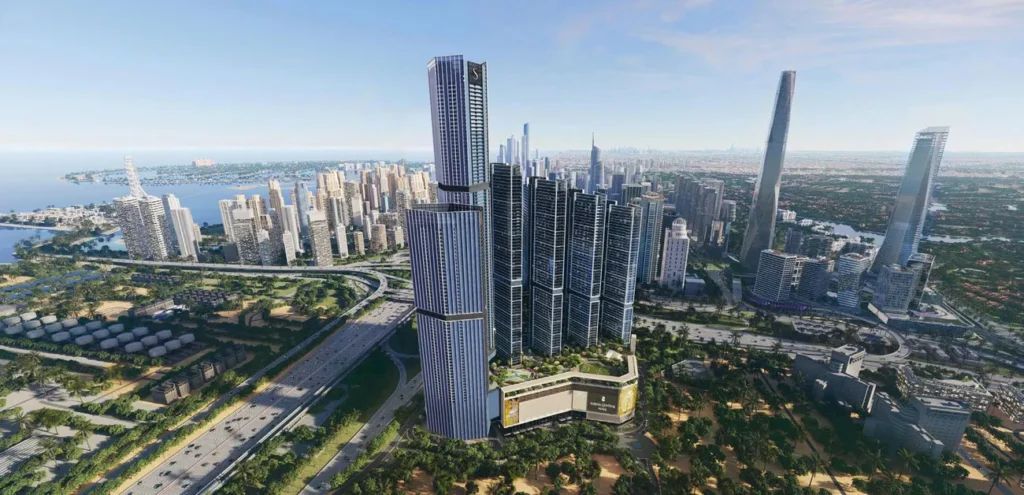
 Dubai Investment Park (Dubai)
 from 197м²
What Sets Residential Towers Apart
One of the defining characteristics of Dubai Marina is the substantial variation between individual residential towers. This is not a marketing observation, but a practical reality that should be taken into account when choosing an apartment.
The building’s age can affect the condition of its engineering systems, layout standards, and finishes, although maintenance history and management quality are equally important. Some of the district’s earlier developments, completed around the turn of the 2000s and in the early 2010s, now fall firmly into the secondary-market category and show the corresponding signs of age and wear. Newer towers may use more recent façade, glazing and engineering solutions, but age alone is not a reliable indicator of building quality. Layout efficiency, maintenance history and management should be assessed separately.
Building management is a factor rarely discussed in area overviews, yet it has a direct effect on day-to-day living. The quality of building management can have a significant influence on the maintenance of lifts, common areas, facilities and the handling of technical issues. A poorly managed tower in an otherwise desirable neighborhood is a very real possibility in Dubai Marina.
Service charges also vary considerably from one building to another. Some towers have significantly higher annual maintenance costs due to their level of service, additional amenities, or age. These expenses have a direct impact on investment yield calculations and on the overall cost of living for owner-occupiers.
Parking is far from a formality in such a densely developed district. Older towers may have a limited number of parking spaces, while in some projects parking provision is particularly tight relative to the number of apartments. Clarifying exactly what is included before purchasing is important both for residents and for landlords.
Dubai Marina includes residential towers from different development periods and market segments, so well-known building names should not be treated as a substitute for project-specific due diligence. Each development has its own characteristics, age, management standards, service charges, layouts, and price positioning. Different towers may therefore suit different ownership, investment, and lifestyle scenarios.
View, Floor, and Orientation
These three factors have perhaps the greatest influence on the actual living experience, yet they are often underestimated by buyers who focus primarily on size and address.
A marina view overlooking the canal, yachts, and promenade creates a visually rich and animated setting, particularly in the evening. It is a lively, constantly changing outlook. A sea view, by contrast, is generally more open and visually calmer. Some buyers place a premium on the sense of space created by an uninterrupted view of the sea, while others prefer the atmosphere and activity of the marina itself. View type can have a meaningful influence on asking prices and buyer preferences, but the effect varies significantly by building, floor, orientation, and market conditions.
A city view or community view generally means that the apartment overlooks neighboring towers or the surrounding urban fabric. This is not necessarily a disadvantage. Lower-floor units with city views can often offer better value for buyers who do not consider the view a priority.
Floor level affects several aspects at once: noise, openness of the outlook, natural ventilation, and, particularly in such a densely built environment, the likelihood of neighboring buildings obstructing the view. On lower floors, the outlook may be partially or completely blocked by another tower that was not apparent in the original development renders. This is something that should be checked in person rather than assessed solely from a floor plan.
Apartment orientation determines how much natural light the property receives throughout the day and how exposed it is to direct sunlight. West- and southwest-facing apartments may receive stronger afternoon sun, but actual indoor temperatures depend on glazing, shading, façade design, floor level and the building’s cooling system. Orientation should therefore be assessed together with the property’s technical characteristics.
A balcony in Dubai Marina is more than an attractive extra; it is a practically important part of the apartment. For much of the year, balconies can be comfortably used during the morning and evening. The absence of a balcony, or a balcony that is too small to be genuinely usable, can noticeably reduce the sense of connection with the waterfront that attracts many residents to the area in the first place.
Noise is another important consideration, particularly for apartments facing Sheikh Zayed Road or major local streets. Sound insulation varies between buildings, so apartments facing Sheikh Zayed Road or busy local streets should be checked in person with the windows closed as well as open.
Table 1: What to Check When Comparing Apartments in Dubai Marina
| Parameter | Why It Matters | What to Check |
|---|---|---|
| Building age | Affects the condition of engineering systems, layouts, and elevators | Completion year, maintenance history, condition of lifts and engineering systems |
| Management company | Determines the condition of common areas and the response to maintenance issues | Resident feedback and the condition of the lobby, pool, and elevators |
| Service charges | Affect the true cost of ownership and investment returns | Annual service charge in AED per sq. ft. |
| Parking space | A limited resource in a densely developed area | Whether it is included in the transaction and whether it is allocated or stacked parking |
| Floor and view | Directly affect noise levels, natural light, and quality of life | Inspect the apartment at different times of day |
| Apartment orientation | Influences heat exposure and natural light | Check cardinal direction on the floor plan |
| Distance from major roads | Affects noise, air quality, and traffic near the building exit | Conduct an in-person inspection and walk around the building |
| Apartment condition | Resale properties may require renovation or repairs | Arrange an inspection with an independent specialist |
| Liquidity of the unit type | Affects how quickly the apartment can be sold or rented | Compare similar units within the same building |
| Potential nearby development | Future construction may affect views and natural light | Review approved development plans for neighboring plots |
Property Prices and the Real Estate Market
Dubai Marina has one of the widest apartment price ranges of any residential district in Dubai, which in itself reflects the diversity of the available stock. The average price across the area can be a useful initial benchmark, but it is not enough to support an informed purchasing decision.
The district-wide average is useful only as a reference point. When making a buying decision, it is far more important to compare similar apartments in buildings of a comparable standard.
Apartment prices in Dubai Marina are shaped by a wide range of factors, many of which are not immediately apparent when browsing listings. Two apartments of the same size in Dubai Marina can be priced very differently depending on the building, floor, view, condition and ongoing ownership costs.
Asking prices in Dubai Marina vary widely by tower, unit type, floor, condition, and view. Current listings should therefore be checked at the time of purchase and compared with registered transaction data from the Dubai Land Department. Waterfront views, higher floors, larger layouts, and newer or better-maintained buildings may command higher asking prices, but the premium varies from one property to another.
Dubai Marina’s rental market is similarly varied. Rental rates are influenced by many of the same factors that determine sale prices. Dubai Marina has a well-established rental market, although demand, occupancy and achievable rents vary by period, building, apartment type and rental strategy.
Table 2: What Influences an Apartment’s Value
| Factor | Potential Impact | What Buyers Should Consider |
|---|---|---|
| View (marina, sea, city) | One of the most significant pricing factors | Compare apartments with genuinely similar views |
| Floor level | Affects the view, noise levels, and sense of openness | Check the actual view and any obstructions in person rather than relying on renders |
| Building age | Building age can influence pricing, but newer does not automatically mean more valuable | Weigh age against layout quality, construction standards, and building management |
| Condition and renovation | Resale properties may require additional investment | Allow for refurbishment or repair costs in the overall budget |
| Furnishing | Furnishing can affect the asking price, depending on its quality and condition | Assess the quality of the furniture rather than simply whether it is included |
| Parking space | In an area where parking can be limited, it can affect both price and liquidity | Confirm whether the space is allocated, stacked, or rented |
| Building quality and management | Indirectly affects demand and achievable rental rates | Compare service charges across towers of a similar standard |
| Location within Dubai Marina | Proximity to the waterfront, promenade, metro, and major roads all matter | Visit the location at different times of day |
| Apartment size and layout | Unusual or inefficient layouts can reduce liquidity | Look at the practical relationship between room sizes and total floor area |
Everyday Infrastructure
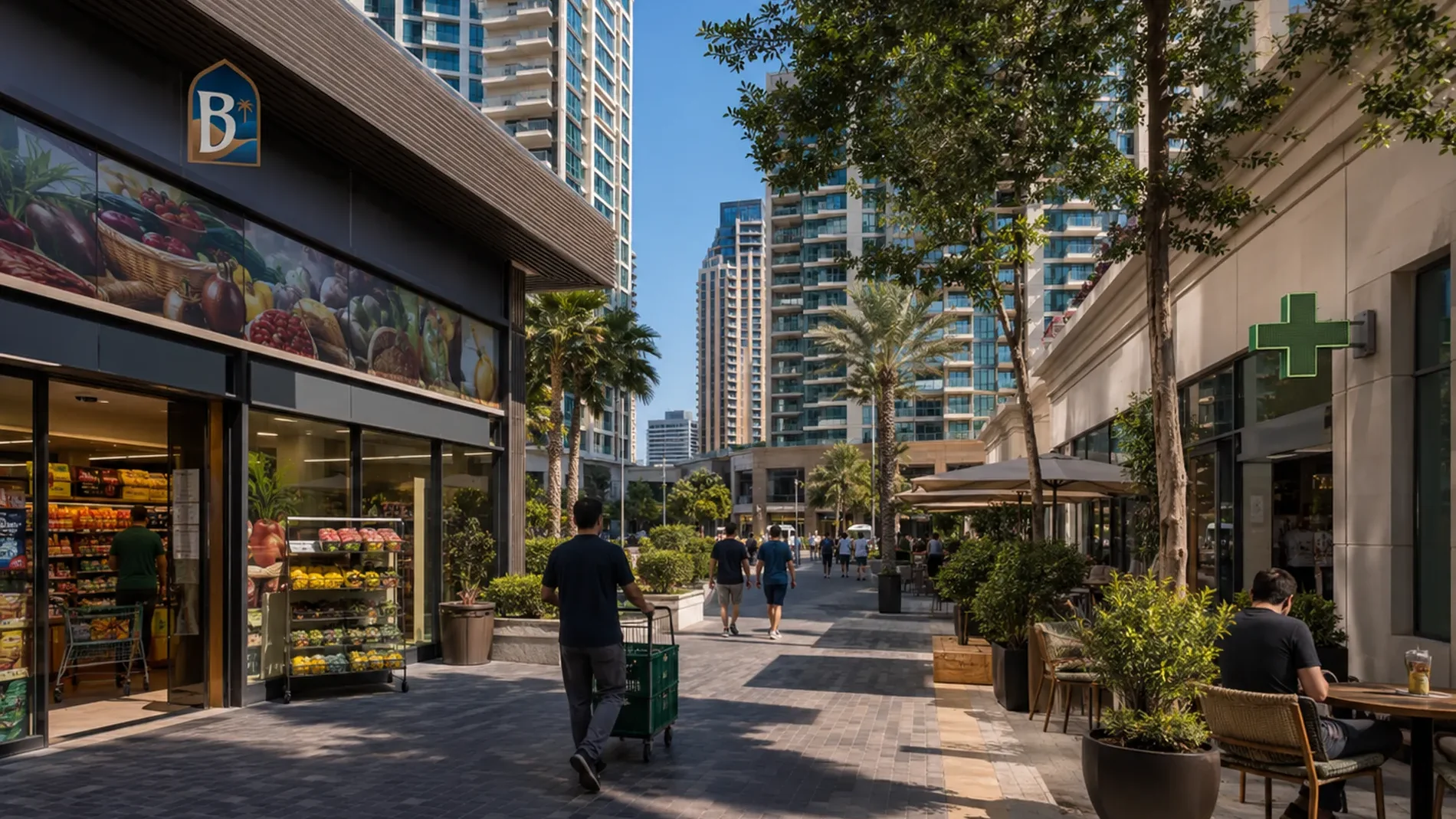
One of Dubai Marina’s genuine advantages is the ability to meet most everyday needs without leaving the neighborhood—or, in many cases, without relying heavily on a car. This is not simply a marketing claim, but a practical result of the area’s high-density development and the fact that it has evolved over many years into a mature residential district.
Groceries and everyday shopping. The neighborhood is served by several supermarkets, including Spinneys, Waitrose, and Carrefour. Marina Mall, located in the northern part of the district, offers a broader retail mix, ranging from groceries to electronics and clothing. For smaller day-to-day purchases, residents also have access to numerous mini-markets and convenience stores located within residential developments.
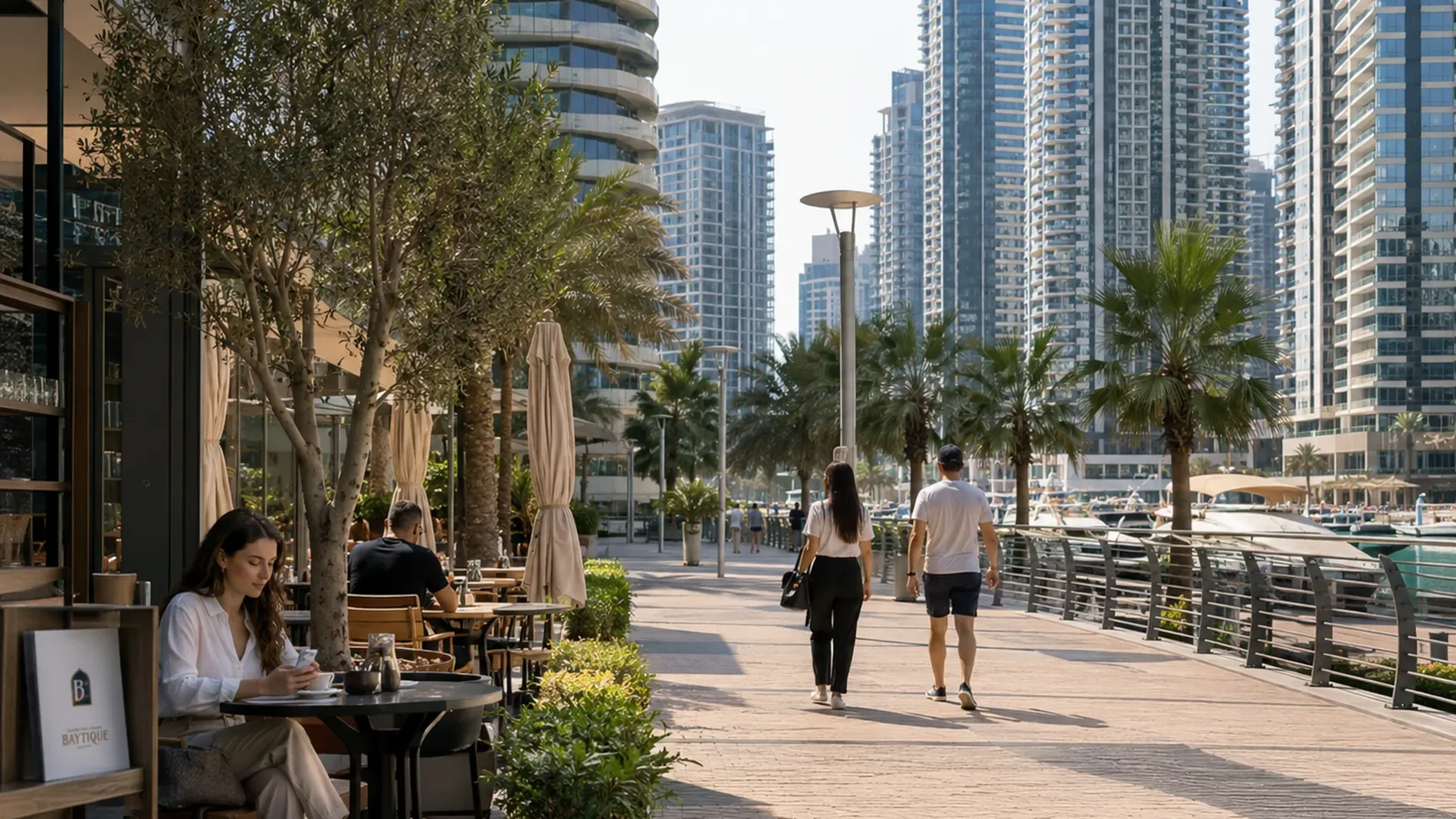
Restaurants and cafés. Marina Walk functions, in effect, as a long waterfront dining promenade. It offers a wide range of cuisines, including Middle Eastern, Italian, Japanese, Indian, and fusion concepts. The options cover both casual everyday dining—coffee shops, brunch spots, and quick lunches—and more upscale restaurants suitable for an evening out.
Fitness and an active lifestyle. Most residential towers have their own gyms and swimming pools, although the quality of these facilities and the standard of maintenance vary from one building to another. Marina Walk also provides routes for jogging and cycling. In neighboring JBR, residents have access to a public beach and a range of water sports.
Pharmacies and healthcare. Several pharmacies operate within the district. Local healthcare options include general practice clinics and private outpatient medical centers. Larger specialist clinics and hospitals are located in nearby areas, including Al Barsha and Dubai Healthcare City, and generally require a trip by car or taxi.
Nurseries and schools. Dubai Marina has nurseries and early-learning facilities, while many school-age children attend schools in surrounding communities such as Al Barsha, JVT, Emirates Hills, and Jumeirah. As a result, school commuting often requires a car, taxi, or organised school transport, depending on the chosen school.
The waterfront and leisure. Marina Walk plays a central role in the neighborhood’s everyday recreational life. Long-term residents often describe it as one of Dubai Marina’s defining qualities: evening walks along the water, morning runs, or simply sitting in a café overlooking the yachts are all possible without making a special trip. For those who want a wider range of leisure options, Dubai’s attractions are accessible across the city, with several located close to the Marina itself.
What Dubai Marina residents can typically access as part of everyday life:
- Several supermarkets, including Spinneys, Waitrose, and Carrefour
- Marina Mall, offering a broad range of retail options
- A wide variety of restaurants and cafés along Marina Walk
- Pharmacies and general practice clinics
- Nurseries and early-learning centers, with schools located in nearby districts
- Gyms and swimming pools in most residential towers
- Marinas, boat facilities, and water transport
- Walking access to JBR Beach
Transportation and Getting Around
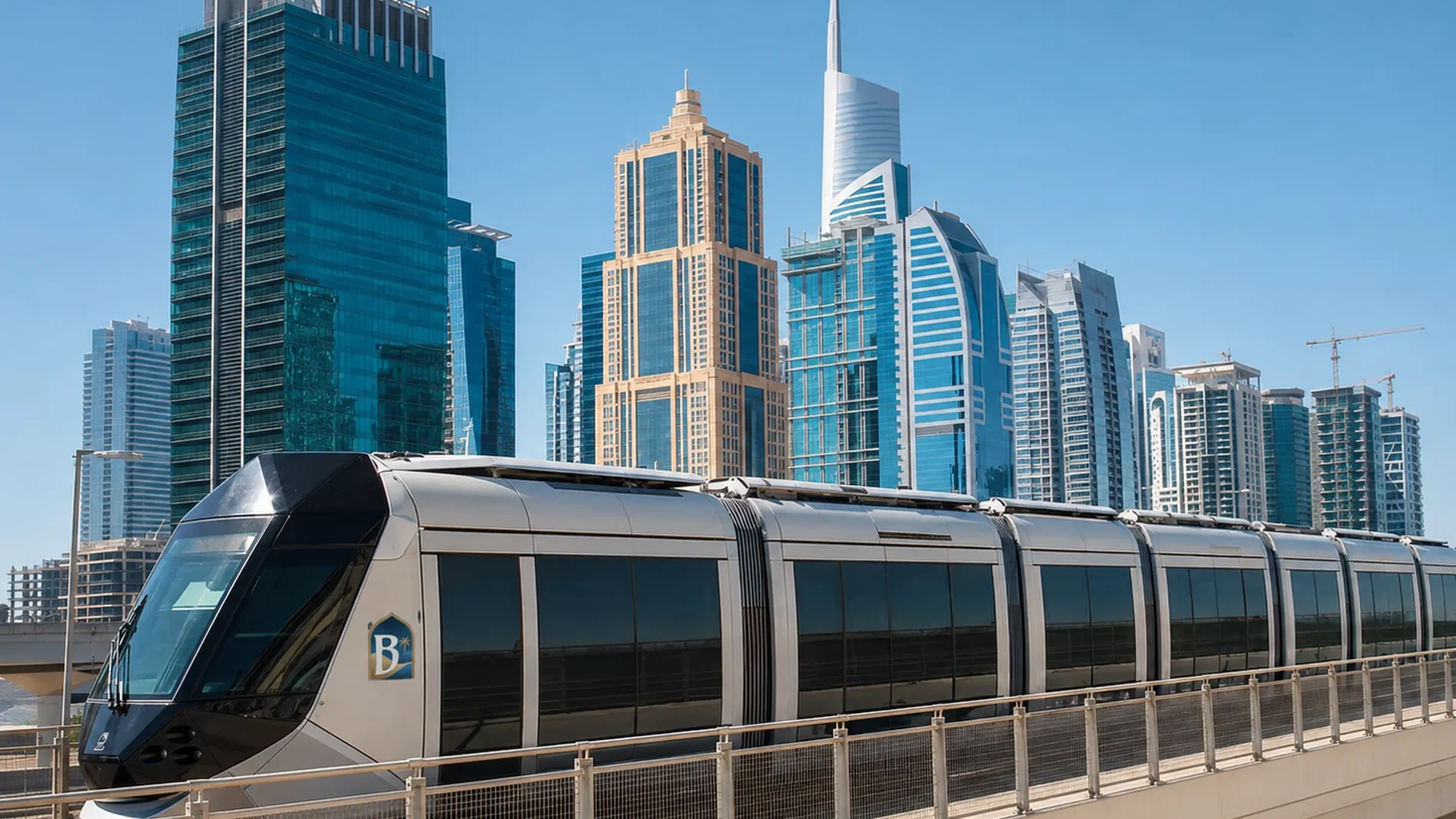
Dubai Marina’s transport infrastructure is one of the area’s major strengths, but it is more nuanced than simply being “close to the metro.”
Dubai Metro. The nearest Red Line stations serving the wider Dubai Marina area are Sobha Realty and DMCC. The metro provides direct connections to key business and commercial districts, including Downtown Dubai and Business Bay, as well as Dubai International Airport without the need to change lines.
Dubai Tram. The tram runs directly through Dubai Marina and JBR, with several stops serving residential, retail, and waterfront areas across the district. It connects with the metro network at interchange points serving Sobha Realty and DMCC stations.
One important distinction is that “close to the metro” and “close to the tram” are not the same thing. Towers in the central part of Dubai Marina along the canal may have convenient tram access while still being noticeably farther from the nearest metro station. This can make a noticeable difference to daily commuting patterns and the overall convenience of living without a car.
Bus services. Several RTA bus routes operate within and around Dubai Marina. Buses are a more affordable alternative to taxis, although they can be less convenient during peak periods when both pedestrian and road traffic are heavy.
Taxis and ride-hailing services. Uber and Careem operate throughout the area. However, during rush hour and on weekends, waiting times can increase significantly because of congestion. Congestion can increase journey times during weekday morning and evening peak periods, and the ease of reaching Sheikh Zayed Road varies considerably from one tower to another.
Driving and traffic. Sheikh Zayed Road is a major high-speed artery, and access to it can become noticeably more congested during weekday morning and evening peak periods. The location of a particular tower in relation to the nearest highway exit can therefore have a meaningful impact on travel time. Internal roads within Dubai Marina also tend to become heavily congested on weekends.
Parking. Free public parking is limited in Dubai Marina, so residents generally rely on spaces allocated to their residential buildings or on paid parking options. Buyers who drive regularly should confirm exactly what parking is included with the apartment before purchase.
Water transport. RTA marine services operate from Dubai Marina, including local routes within the marina and scheduled Dubai Ferry services towards Palm Jumeirah and Atlantis. Routes and timetables should be checked with RTA before travel. For most residents, this is more of an enjoyable alternative than a practical everyday commuting option, but it does add another car-free way to move around the area.
Walkability. Marina Walk offers a convenient and generally safe pedestrian environment. Residents can easily walk between nearby towers, restaurants, supermarkets, the waterfront, and tram stops without needing a car or other form of transport. During the summer, however, comfortable walking is usually limited to the early morning and late evening.
Table 3: Getting Around Dubai Marina
| Mode of transport | Best for | Limitations |
|---|---|---|
| Walking | Waterfront, restaurants, shops, tram stops | In summer, mainly comfortable in the morning and evening |
| Metro (Red Line) | Downtown, airport, business districts | Not all towers are close to a station |
| Tram | Getting around the district, metro connections, JBR | Limited to the Marina Walk and JBR corridor |
| Car | Trips outside the district, families with children | Rush-hour congestion and parking constraints |
| Taxi / Uber | Occasional journeys, airport transfers | Longer waits at peak times and more expensive than the metro |
| Water transport | Leisure trips, Palm Jumeirah | Not practical for most daily commutes |
What It’s Like to Live in Dubai Marina
Living in Dubai Marina involves a series of trade-offs that most residents accept as a deliberate choice. People are drawn to the area not despite its defining characteristics, but often precisely because of them.
What genuinely works. The waterfront lifestyle is one of the area’s clearest strengths: evening walks along the promenade, yachts in the marina, illuminated towers reflected in the water, and cafés overlooking the canal. For permanent residents, this is not simply a tourist attraction but part of everyday life. The concentration of services also makes it possible to handle most daily needs without leaving the neighborhood: restaurants, gyms, pharmacies, cafés, and other essentials are all close at hand. Public transport works reasonably well for residents who do not rely on a car for their daily commute. The wide range of apartments available also means buyers and tenants can find options suited to different budgets and purposes.
What you need to be prepared for. Tourism is an inseparable part of life in Dubai Marina. Marina Walk can become very busy on weekends. Sightseeing yachts, tour groups, and crowded restaurants create an atmosphere that some residents enjoy and others find tiring. Traffic and parking are recurring concerns. Reaching Sheikh Zayed Road during the morning rush hour often requires either leaving early or accepting that part of the journey may be spent in congestion. Noise can also be a constant factor depending on the tower and the floor: trams, road traffic, and bars operating late into the night can all contribute. From June through September, the summer heat effectively keeps residents indoors during much of the day, significantly changing the character of the waterfront and its otherwise walkable lifestyle.
Differences in the quality of individual towers are another part of everyday life here. Two neighboring buildings with virtually identical locations can offer very different standards of management, maintenance of common areas, and levels of noise.
Table 4: Dubai Marina for Different Lifestyles and Buyer Profiles
| Scenario | How Suitable Is It? | What to Consider |
|---|---|---|
| Young professional | Well suited | Commute options, studio or 1-bedroom apartment, service charge budget |
| Couple without children | Well suited | Local amenities, waterfront lifestyle, restaurant scene |
| Family with children | Suitable with reservations | School commute may require travel to surrounding communities |
| Buyer without a car | Well suited | Choosing a tower close to the tram or metro |
| Investor | Requires careful analysis | Specific building, service charges, rental strategy |
| Buyer seeking a holiday home | Well suited | Short-term rental between visits, property management |
Buying an Apartment as an Investment
Dubai Marina remains an established part of Dubai’s residential investment market, supported by its waterfront location, transport links, international profile, developed infrastructure, and broad apartment stock. These characteristics can support buyer and tenant interest, but none of them guarantees demand, capital appreciation, occupancy, or a particular return for an individual property.
Factors that support rental demand in Dubai Marina include:
- Proximity to Dubai Media City and Dubai Internet City, which attracts international professionals
- International buyer and tenant interest in waterfront locations, although demand varies by market conditions and individual property characteristics
- Visitor activity that can contribute to demand for licensed holiday-home accommodation
- Well-developed public transport, making the area convenient even for residents without a car
- A wide variety of apartment types, catering to a broad range of tenant profiles
The investment potential of an apartment in Dubai Marina is determined not by the district name alone, but by the combination of purchase price, the specific building, operating costs, views, layout, and demand for comparable properties.
Long-term rentals can provide a more predictable occupancy pattern than nightly holiday-home letting, although vacancy risk and achieved rents still depend on the property and market conditions. Many tenants move to Dubai for work and stay for a year or longer; for them, transport links, building quality, and the convenience of the surrounding area are key considerations.
Short-term holiday-home letting is possible in Dubai, but the unit must comply with the Dubai Department of Economy and Tourism (DET) Holiday Homes requirements. The owner or professional operator must use the DET Holiday Homes system and obtain the applicable permit before operating the property as a holiday home. Nightly rates can be higher than the equivalent daily value of a long-term lease, but short-term letting also involves more variable occupancy, higher operating costs, and more active management. Features such as views, floor level, apartment condition, and building amenities can influence the attractiveness of a unit in the short-term rental market, but their impact varies by property and season.
Risks and limitations should also be taken into account. High competition between similar properties within the same district can weaken a landlord’s negotiating position. Service charges in some towers can significantly reduce net returns. Resale properties may require additional investment before they are ready to rent out. Market conditions also change over time, and past performance does not guarantee future results. The choice between long-term and short-term rental strategies should therefore never be based solely on Dubai Marina averages; the specific building, floor, view, and comparable properties must all be analysed.
How to Choose an Apartment
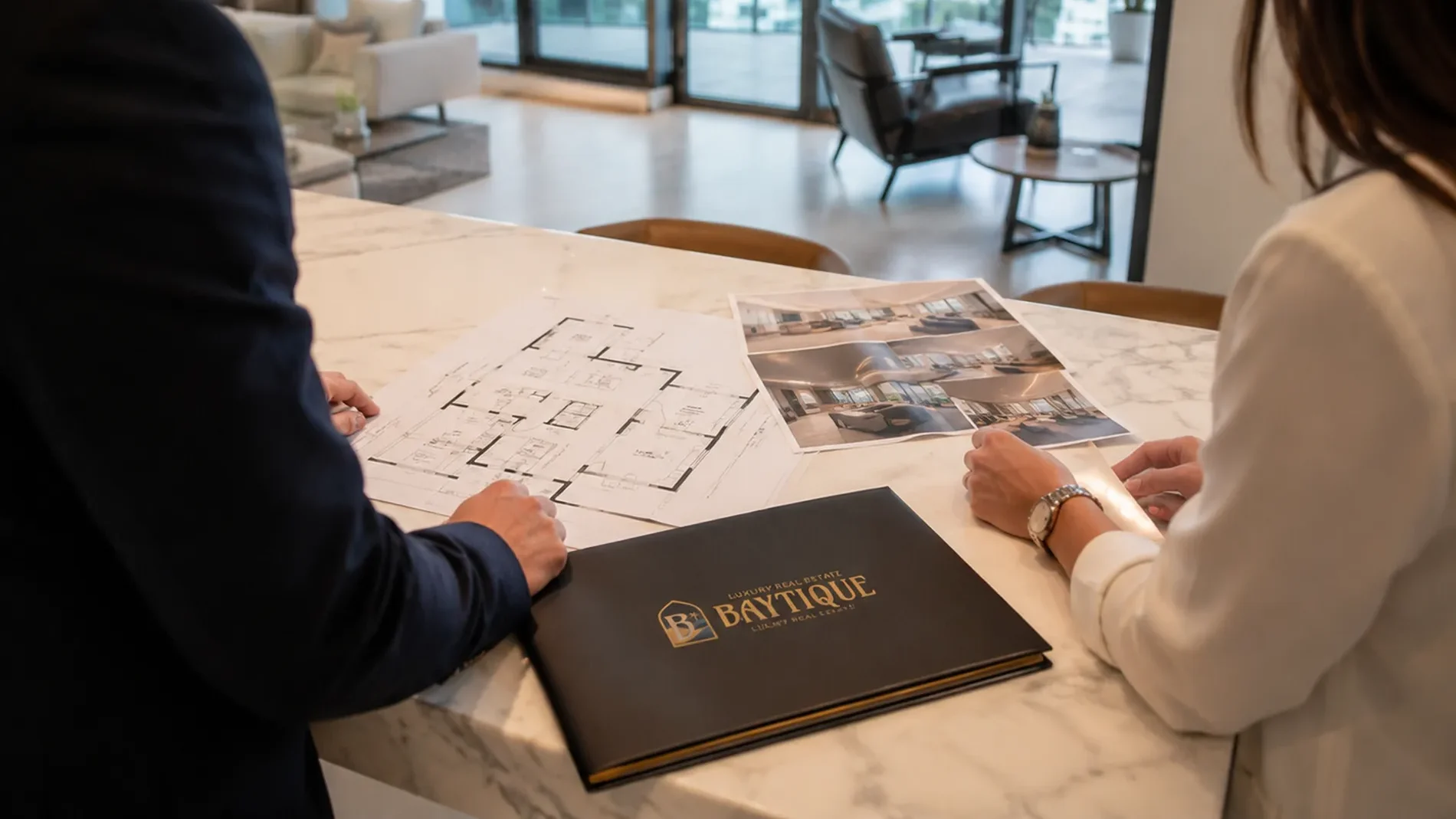
Choosing an apartment in Dubai Marina is not simply a matter of choosing the district itself. It also means selecting the right tower, floor, view, and property characteristics. The following process can help make that decision more systematic.
1. Define the purpose of the purchase. Owner-occupation, long-term rental, short-term rental, or a combination of these scenarios will each place different demands on the property. For personal use, factors such as noise levels, orientation, views, and commuting time matter most. For long-term rental, the liquidity of the apartment type and the quality of the building are particularly important. For short-term rental, views, floor level, and licensing status become more significant.
2. Establish your true budget. Include service charges, renovation costs if applicable, agency fees, DLD fees, and any initial furnishing expenses.
3. Decide which part of Dubai Marina suits you best. Living closer to the waterfront, the metro, JBR, or major retail facilities creates a different day-to-day experience. Walk through each area you are considering at different times of day before making a decision.
4. Assess transport accessibility in person. Walk from the prospective building to the nearest tram stop and metro station. If the property is for your own use, test the morning commute to your workplace.
5. Research the building itself. Check its age, management company, condition of common areas, reliability of the lifts, and the state of facilities such as the swimming pool and gym. If possible, speak to the concierge or current residents.
6. Confirm the service charge. This is an annual ownership cost that can materially affect overall expenses. Service charges vary by building and budget year and can materially affect the total cost of ownership. Buyers should verify the approved charge for the specific property through the Dubai Land Department Service Charge Index rather than relying on a district-wide estimate.
7. View the apartment at different times of day. A morning viewing will show how much natural light the unit receives. An evening visit will give you a better sense of the actual view and noise levels. Viewing during rush hour will also help you assess traffic conditions around the building.
8. Verify the actual view from the property. Do not rely solely on renders or listing photographs; stand by the window or on the balcony and assess it yourself. Ask whether any approved new tower developments are planned within the current view corridor.
Not sure which part of Dubai Marina or which type of property best fits your goals? Take the short World Estate Homes property-matching quiz to narrow down the options based on your budget, purchase objectives, and preferences: find a property.
9. Request the property’s history. Ask about previous tenants, renovation or refurbishment dates, any outstanding service charge payments, and the status of the property documents.
10. Compare like-for-like listings. Do not rely on an abstract average price for Dubai Marina. Compare apartments of a similar type, floor level, and view in the same building or in the closest comparable towers.
11. Evaluate the parking arrangement. Whether the apartment includes a parking space, what type it is—allocated, stacker, or mechanical—and where it is located can affect both day-to-day convenience and the property’s resale appeal.
Before purchasing a resale property, it is worth commissioning an independent technical inspection. For a resale property, an independent technical inspection can help identify visible or detectable defects and provide the buyer with additional information before completing the purchase.
Who Dubai Marina Is Best Suited For
Dubai Marina is a well-established, mature neighbourhood with a distinct character and its own way of functioning. It will not suit everyone equally well—and that is true of any fully developed urban district.
Dubai Marina is particularly well suited to:
- People who value a lively urban environment, with restaurants, cafés and the waterfront forming part of everyday life
- Those for whom water views and a walkable waterfront setting are genuine priorities rather than simply attractive marketing features
- Apartment buyers, thanks to the area’s mature property market and broad range of available options
- People working in Dubai Media City, Dubai Internet City or other nearby business hubs
- Those who are comfortable using—or actively prefer—public transport
- Investors who are prepared to assess individual towers and properties carefully rather than relying on Dubai Marina’s reputation as a whole
The area may be a less obvious choice for:
- People looking for peace and quiet, low-density development and a greater sense of privacy
- Families with school-age children for whom having a school within walking distance is essential, as there are no schools within Dubai Marina itself
- Buyers looking for a villa with a private plot and garden
- People who commute by car every day during peak hours and are unwilling to deal with regular congestion when entering or leaving the area
- Buyers focused primarily on securing the lowest possible price per square metre, as Dubai Marina is not among Dubai’s cheapest districts by this measure
Ultimately, the experience of living in Dubai Marina depends heavily on the specific tower, the apartment’s location within the building, a person’s lifestyle and the purpose of the purchase. When chosen deliberately and with a clear understanding of its particular characteristics, Dubai Marina can offer a complete and highly functional residential environment. When chosen simply because “it is a beautiful area,” it can just as easily lead to disappointment.
Conclusion
Dubai Marina has evolved into a fully established residential community, with clear strengths, sustained demand, and genuine limitations. Its combination of waterfront living, well-developed urban infrastructure, public transport, and a broad apartment market makes it one of the few areas in Dubai where most day-to-day needs can be met within walking distance.
At the same time, Dubai Marina is far from uniform. The experience of living here depends less on the district as a whole than on the specific tower: its position relative to the waterfront and major roads, the quality of building management, and the condition of the individual apartment. Buyers who assess these factors before completing a purchase are likely to make a far better-informed decision than those who focus only on the Dubai Marina name and average market prices.
The Dubai Marina property market is mature enough to offer a wide range of options, yet diverse enough that every individual property still requires careful evaluation.
 Real estate in Georgia
 Real estate in Cyprus
 Real estate in Montenegro
 Real estate in Bali
 Real estate in Thailand
 Real estate in Spain
 Real estate in Saudi Arabia
 Real estate in Turkey
 Real estate in Zanzibar
 +971 50 108 6910
 hello@baytique-uae.com
 UAE, Dubai, Dubai Hills Estate, Park Heights Square 1


 Get catalogue of TOP-7 objects